
The weather forecast for the Keys for a few days out was for the arrival of gale force winds and unusually cold temperatures. We decided to cut short our time in Key West so that we had time to make it to Islamorada to settle in before the ferocious winds arrived. We can handle the cold weather at anchor, but with 40 to 50 mpg winds on the way, we wanted to be secured in a protected dock. We released the mooring lines at Key West shortly after 08:00 on January 24th, wound our way around Fleming Island, then through the channels following the north side of Key West, and finally turned east towards the Middle Keys. As soon as we rounded the tip of Key West proper, we were greeted again by blankets of crab pots in Hawk Channel (the “outside route”, as opposed to the Florida Bay route), so we were back to vigilantly looking for crab pot buddies.
As the day progressed, the wind and waves increased; it was a real slog with waves breaking over the bow and spray onto the front windshield. It was nice to have working windshield wipers (a multi-month project completed just before we left PC, but that is a story for another day). As we approached Marathon and the Seven Mile Bridge, we decided to duck through to the Florida Bay side of the islands; being offshore was just plain uncomfortable. We tried multiple times throughout the afternoon without success to reach Marathon Yacht Club by phone and radio because we really wanted to go in there to get out of the weather. Since their website said their bar opened at 16:30 that afternoon, we continued towards the club and when we saw that the T-dock space was empty, we tied up temporarily and went into the club to see if we could find somebody that could give us permission to stay at the dock overnight. We learned that the club was closed for a private event hosted by their commodore to honor the club volunteers (which is why we had been unable to reach anyone on the phone during what would have normally been their regular business hours). Ultimately the club commodore arrived in advance of his event, and he kindly gave us permission to stay where we were docked for the night. A woman who lived on the boat docked next to us gave us several recommendations for good restaurants that were within walking distance. We walked a few blocks to the Cuban restaurant she had recommended, El Siboney, and enjoyed some traditional Cuban food. Marathon Yacht Club’s motto is “The world’s friendliest club,” and it certainly lived up to that once again.


When we went to bed that night, our plan for the next day was to make the 50-mile trip all the way to Treasure Harbor, where we had made arrangements to stay in a private slip tucked into a 360-degree hurricane hole on the ocean side of Islamorada. We would have to time our entrance into Treasure Harbor to be within an hour or so of high tide, which would be around 14:00 the next day, so we set our alarms for 06:00 with plans to leave just before first light. We got off the dock early as planned, and as we headed east towards Islamorada, the southeast winds steadily increased until it was consistently blowing just under 20mph. Our ride in Florida Bay was protected from wind driven waves (as the island was between us and the southeast wind), but to reach Treasure Harbor we would have to go outside again at Snake Creek and be exposed not only to the strong winds, but also to the big waves that had doubtlessly built up all day. Since the entrance to Treasure Harbor is extremely shallow and tricky, we started to weigh whether we should delay our arrival there by a day with the expectation that the wind would calm a bit and shift to a more favorable direction the following day. After a few phone calls to gather local knowledge and opinions, we decided to spend the night at Cowpens Anchorage, tucked close to shore and protected from the wind, and as the crow flies almost directly across the island from Treasure Harbor. It is located just around the corner from the cut at Snake Creek where we would need to cross from Florida Bay to the ocean side. The weather was warm (as it turns out, the only day of our entire time in the Keys with warm weather), so George went for a swim and inspected the bottom of our boat.

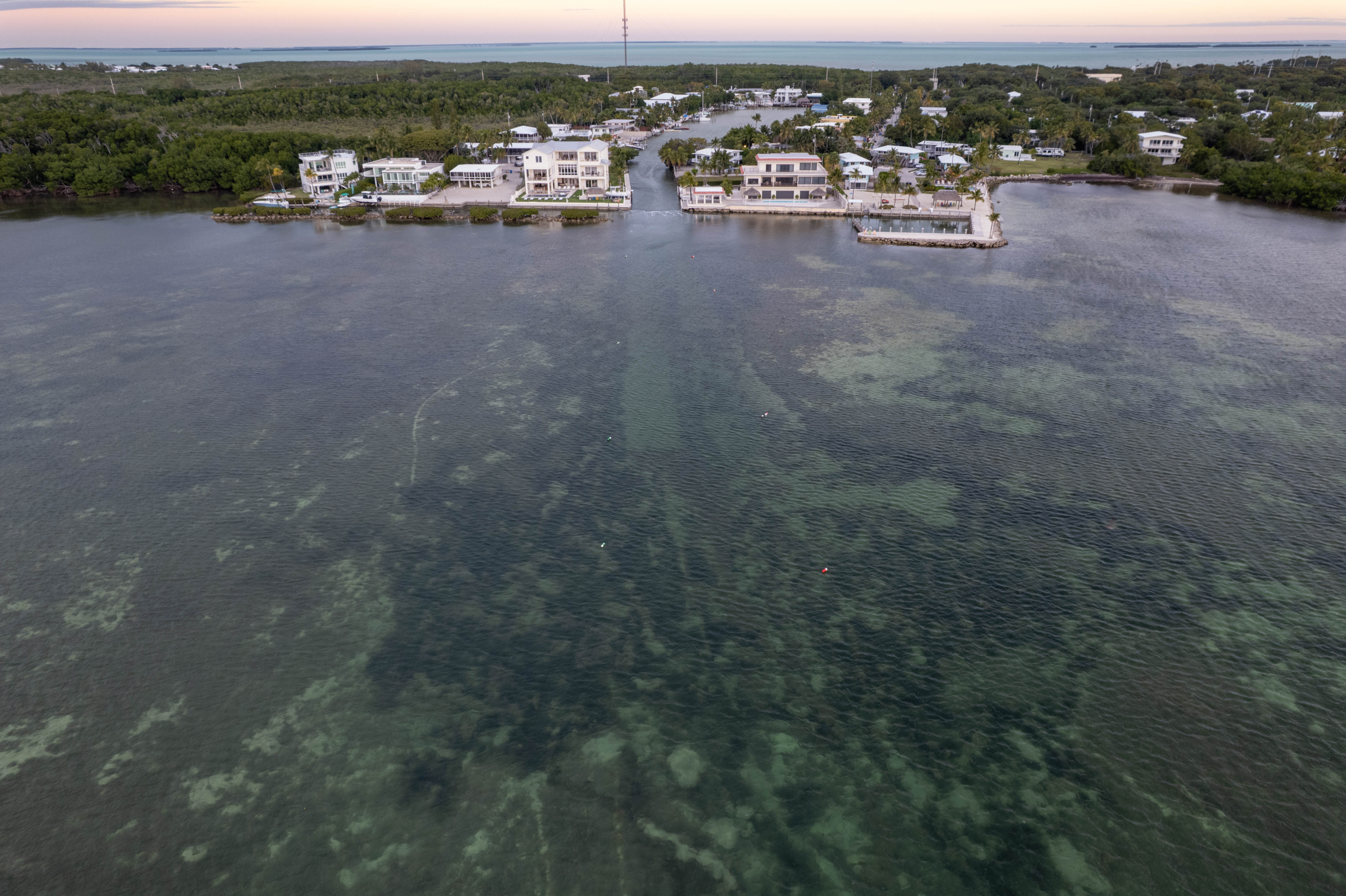
The next day, as hoped, the wind abated and shifted to a more favorable direction. We had to wait until early afternoon to head to Treasure Harbor because our approach needed to coincide with close to high tide (14:40). On the charts, the depth shown for the approach to the Treasure Harbor is 0’ (never a good thing). We had learned, however, that there existed a privately marked route through the shallows that is not shown on the charts, but can be located by projecting a line of sight between an offshore tower and another radio tower located onshore, and if you cross your fingers, and hold your tongue a certain way, and you make sure you are there no more than an hour before high tide, you can most likely enter the channel without running aground. It is always a bit of excitement getting in and out of Treasure Harbor, especially when we haven’t been there in a while.
Treasure Harbor is a former quarry and years ago, back in the day when such things were allowed, someone bought the old quarry and used dynamite to open a channel from the quarry to the ocean, creating a small deep-water harbor which the ocean now fills. We have been bringing our boats to Pam’s dock slips at Treasure Harbor since at least 2014. In those days, it was our catamarans, first Bene Vita, and then later her replacement, Sail La Vie. On one occasion, we left a boat there for three months and traveled periodically back and forth from Panama City to spend a week or two at a time in the Keys. When our son Taylor was in college, we used this as our hand off point when we would lend he and his friends the boat during their school breaks. After we raced to Cuba on Bene Vita, this is where we returned to drop off the crew so they could return to their jobs before we returned the boat to Panama City. Over the years, we became friends with Pam, and even after she sold the marina she has kindly let use one of the private slips behind her home that is located just next to the marina.

We knew when we first planned our trip that we would want to spend some time in Treasure Harbor, and as it turns out, the timing could not have been better, as there is likely no more protected place in the Keys to ride out ferocious winds from any direction. So, with the bad weather bearing down on us, we carefully approached the entrance to Treasure Harbor on January 26th. Because the Navionics mobile navigation app we use allows us to record and save to our account a visual track of our boat’s movement, we had previously saved short tracks of our approaches and entrances into Treasure Harbor. We were able to locate several tracks going back as far as 2015 to follow on this trip in. When a saved track is pulled up in Navionics, it shows the chart of the area where the track was recorded and in real time shows the current position of your boat relative to the saved track. Since the entrance was solid rock, and not shifting sand, we felt pretty good about following one of our old tracks. As we approached, we were pleasantly surprised to see that since our last visit someone had “upgraded” the scant PVC poles that had previously marked the approach to the channel, and now multiple red and green floats lined the preferred path. Even at high tide, there was only about a foot of water under our props on the approach, but we easily glided through the channel blown through the rock and into the deep water. We backed into the middle slip behind Pam’s house and set about securing the boat with a spider web of lines that would keep the boat in place regardless of the gale force winds headed our way. That evening, however, the weather was beautiful, almost warm, and it was peaceful sitting on the front of the boat enjoying the lovely view of the harbor. For dinner we biked a few miles to the Island Grill, the home of George’s favorite dish in the Keys, Tuna Nachos! He was a very happy man. When we return to the boat, the wind was starting to build, so we double checked the lines, and settled in for the night.


The wind howled all night, and during impressive gusts the boat strained, jerked and heeled over a bit, but the spider web of lines counteracted the worst of it, and we were just fine. The front brought extremely cold temperatures, and the next morning it was hard to appreciate that we were in the Keys. Assisted Living is equipped with a diesel heating system, and although we never expected to use it south of Canada, we were truly grateful to have it at our disposal. George braved the wind and cold to rinse down Assisted Living, which was caked in salt, then spent the rest of the day working on projects both inside and outside the boat. Chris stayed firmly inside the toasty cabin getting caught up on business and laundry. Pam joined us on the boat that evening and though we couldn’t convince her to let us take her to dinner, we had a wonderful visit and she promised to return for a boat tour the next day.

The next day brought even colder temps and rain, and unfortunately another forecast for yet another big wind event in the coming days (projected to be sustained winds of 30+ mph). We resolved ourselves to the fact that we wouldn’t be going anywhere anytime soon, so we settled in, snug as a bug in a rug, thankful to have such a wonderful place to wait out the bad weather. Pam came by with a friend, and we gave them a tour of the boat. She was most impressed with our quiet diesel heat, as she had been worrying about us in the frigid temps.

Pam told us about Freebee, a free on-demand ride service funded by the Village of Islamorada, and it worked like a charm that evening when we called for a ride to take us to another of our favorite restaurants, Mile Marker 88. Since the last time we had visited the restaurant, however, they had eliminated all indoor seating, and although they were open for business and have a gorgeous outdoor venue, it was too cold, blustery and wet to consider sitting outside even in the areas that were partially sheltered. With apologies to the miserable bartenders and servers huddled together in the empty restaurant, we said we would try again another time, and then dodged the nonstop traffic on Highway 1 to go just across the street to M.E.A.T., another restaurant that we had become familiar with during trips to Islamorada for the annual Food & Wine Festival (the festival is sadly no more, reportedly moved to Homestead, FL). After fabulous hamburgers and onion rings, we pinged Freebee and a driver arrived within minutes to deliver us back to the boat. With the weather still lousy, and being unaccustomed to being boat bound, George started to focus on his next meal. The next afternoon, he biked back to the Island Grill for a repeat of Tuna Nachos.
We had originally planned to only stay a few days in Treasure Harbor, and then move the boat over to Buttonwood Sound on the Florida Bay side of Key Largo to watch the on-the-water action at the A Class Catamaran Midwinters Regatta. Since the weather had not cooperated, we instead took an Uber to the Upper Keys Sailing Club on Thursday night and joined our A Cat friends for Argentinian Steak night, one of the highlights of the regatta’s social activities. The steak was as wonderful as we had been told, and it was even better to catch up with so many of the A Cat sailors who come to race in Panama City every year at Caterwaul Regatta. A special highlight was time spent picking the brains of O.H. Rogers and Bob Webbon, both A Cat sailors who keep cruising motorboats on or near Georgian Bay in Canada, which is the part of the loop that we are most eagerly anticipating. We got lots of great intel and suggestions from them both, and now we are rethinking whether one summer in Georgian Bay and Canada will be enough. We have much to ponder.
It was rainy and cool the morning of January 30th, so we slept in and spent the day working on business and boat projects. George was starting to go stir-crazy as he is not used to being couped up inside, and there is only so much entertainment to be had from watching the stunned and frozen iguanas fall from trees and vines (that is a real thing). He stayed busy troubleshooting the issue with our Gyro (no resolution yet, but we have more clues), and looking over materials related to a board he serves on back home. He also took every available opportunity between the bouts of howling gusts to drone both sunrises and sunsets. He has put together a beautiful video of our time in the middle Keys.


The next day while Chris continued computer work on the boat, George biked about four miles to the History of Diving Museum. Not only was the museum excellent, it is a member of the North American Reciprocal Museum Association (NARM), which is an organization we learned of recently from another looper. Members of a participating NARM museum enjoy reciprocal benefits such as free admission and shop discounts at more than 1,000 museums across North America. George purchased a membership to the History of Diving Museum, and we are excited about exploring many of the reciprocal museums along the loop. He had passed a Publix on his bike ride to the museum, so stopped to pick up a few items on his way back; it was an incredibly satisfying and productive trip all around, a perfect antidote to the restlessness of feeling boxed in by the weather. He was thankful that his electric bike now works, because heavy winds and dark clouds chased him all the way back to the boat.


That evening we met a group of A Cat sailing friends for dinner at the Old Tavernier Restaurant. Food and drinks were superb, but the restaurant was so loud that we could only converse with the ones sitting immediately next to us. Fortunately for George, he was seated next to Bob Webbon, who continued to share valuable insights from his extensive experience boating in Michigan, the Great Lakes, Georgian Bay and the canals in Canada. Bob is a retired harbor pilot that spent the bulk of his career piloting large ships and freighters through the Houson ship channel. He also shared valuable information and insights about how the harbor pilot industry and its national association operates. George found it all incredibly helpful and timely.
The wind blew like crazy overnight, but we were secure in the slip in the protected harbor. The next morning we decide that the weather might allow us to leave the following morning, so we spent the day getting the boat and ourselves ready to get back out there – laundry, cooking, boat projects, and the never ending business of living in this upside down world that will be harder to attend to once we also need to attend to the ongoing tasks of a boat underway. We were grateful to be allowed to wait out all the bad weather in such perfect harbor, but we were ready to explore new places.


Comments
3 responses
ok, sounds like you are on the move. love ya
Would love to see the diving museum. Hope all is well on the journey.
Hi Karen! So many things on this trip have reminded us of Jack. We remember him fondly and think of you both often. You would definitely enjoy the diving museum in Islamorada. I am sure Jack had first hand experience with much of the equipment displayed there.