
After a quick few days at home in Panama City, we returned to the boat in Fort Myers on the 17th of January. We arrived just after sunset, dumped all our stuff from the car on the boat and then Chris went shopping for provisions. We had stuffed our four refrigerators, the freezer and the wine cooler so full upon our departure from Panama City that we hadn’t needed to resupply anytime during the first month of our trip. George was left to organize everything we brought back to the boat from Panama City (What were we thinking bringing all this stuff back Where were we going to put it all?). As soon as Chris returned from shopping, George returned the rental car, then we readied the boat for an early departure the next morning. The forecast was calling for a gale to come through the next afternoon, so we wanted to leave early to make sure we were tucked in at Naples before bad weather arrived.

The open gulf was nice and flat, making for an easy ride. To make sure we were ahead of the weather, we cranked up the engines to run at 18 miles per hour for part of the trip. Our usual cruising speed is around 8 miles an hour, which is our sweet spot for fuel consumption. However, the whole point of getting a boat that could go fast was so we would have the ability to get ahead of weather when needed. It certainly came in handy in this instance. Eventually it was the ubiquitous crab pots that blanket the southwest Gulf and not our wallet that caused us to slow to 12 – 13 miles per hour.
The wind started to pipe up just as we were settling into our slip at Naples Yacht Club, and about an hour after we arrived, Chris looked up to see a solid black wall moving in from the west. We scrambled to get some additional lines on, but before we could finish, the black wall of wind hit with a vengeance. There were sustained winds of 30, with gusts quite a bit higher. We somehow managed during the worst of the wind to get an additional line on the center forward piling dividing our slip from the slip immediately next to us. That involved a loop, a lasso, an extended boat hook, and both of us being pummeled with wind and rain while trying not to be blown off the boat. The additional lines kept the boat off the dock.
The Naples YC docks are just next to the Naples City mooring field, and we huddled inside Assisted Living watching the boats on moorings spin around and violently heave side to side. The sailboat on a mooring directly in front of us was knocked down. It blew hard for hours. The Bimini on our flybridge rattled and banged and we feared it would be torn off, but we were not about to venture out again to try to fold it down during the bad weather. (Note to Self: Next time we are expecting a big blow, take the Bimini down before it hits, duh). We just waited it out; happy to be somewhat secured in a slip and not offshore or at anchor. And Jeanne of CB Sails, thanks to all your good work reinforcing all the stitching on the Bimini before we left, it survived with no obvious damage!
After the storm passed, we were joined on Assisted Living by some dear friends who used to live a few doors down from us in Panama City, Michael and Joan. Micheal and Joan had moved to Naples several years ago and we were so happy to spend some time with them and Michael’s brother and sister-in-law, Ken and Joy, who were in Naples visiting. Michael and Joan treated us all to a lovely dinner at a nearby restaurant, Bleu Provence. The company and the food were both spectacular.
Although we had originally planned to depart Naples the following morning, the wind was still blowing strongly from the north, so we decided to stay an extra day. Since we had seen for ourselves that the City moorings held up well in the big blow, we moved over to an open mooring ball for the night ($20/night – what a deal; almost as good as the one-night’s free dockage at FCYC clubs). The boats on the moorings on either side of us were flying AGLCA looper flags, so we contacted them using the Nebo App and invited them to join us on our boat that evening for happy hour. It was fun to get to know Alan from WY Knot II and Dennis and Debbie from Wild Goose. We traded stories and tips and laughed a lot. Dennis and Debbie returned to their boat to watch the college football national championship game, and Alan hung out with us to do the same. We only made it to half time and called it a night at “Looper midnight” (a/k/a 9 p.m.).
The wind blew strong from the north and northeast throughout the night, causing the boat to dance around the mooring ball with alternating jerks and squeaks from port and then starboard mooring lines as the boat reached each extreme side of its swing. For those of you who are not boaters, a mooring is a floating ball that is secured to the seabed and has a metal ring on top that is used to secure a boat to the mooring. The best way to attach a boat to a mooring is to use two lines threaded through the top metal ring, and then both ends of each line are brought back to the front of the boat and one line attached to the boat’s forward port cleat, and the other line attached to the boat’s forward starboard cleat. We are not sure why we experienced so much jerking and squeaky as the boat moved from side to side around the mooring ball, but we do know that it made for a restless night. Another consequence of the strong north wind was that it pushed water out of the bay, so when we awoke the next morning, low tide was lower than normal, leaving only about a foot of water under the boat. Since we had seen a sailboat trying to leave the mooring field the day before run hard aground, we settled in to wait for the tide. We had a productive morning working on the boat and when the tide came in, we fueled up at Naples Yacht Club and headed out for our next stop, Marco Island.
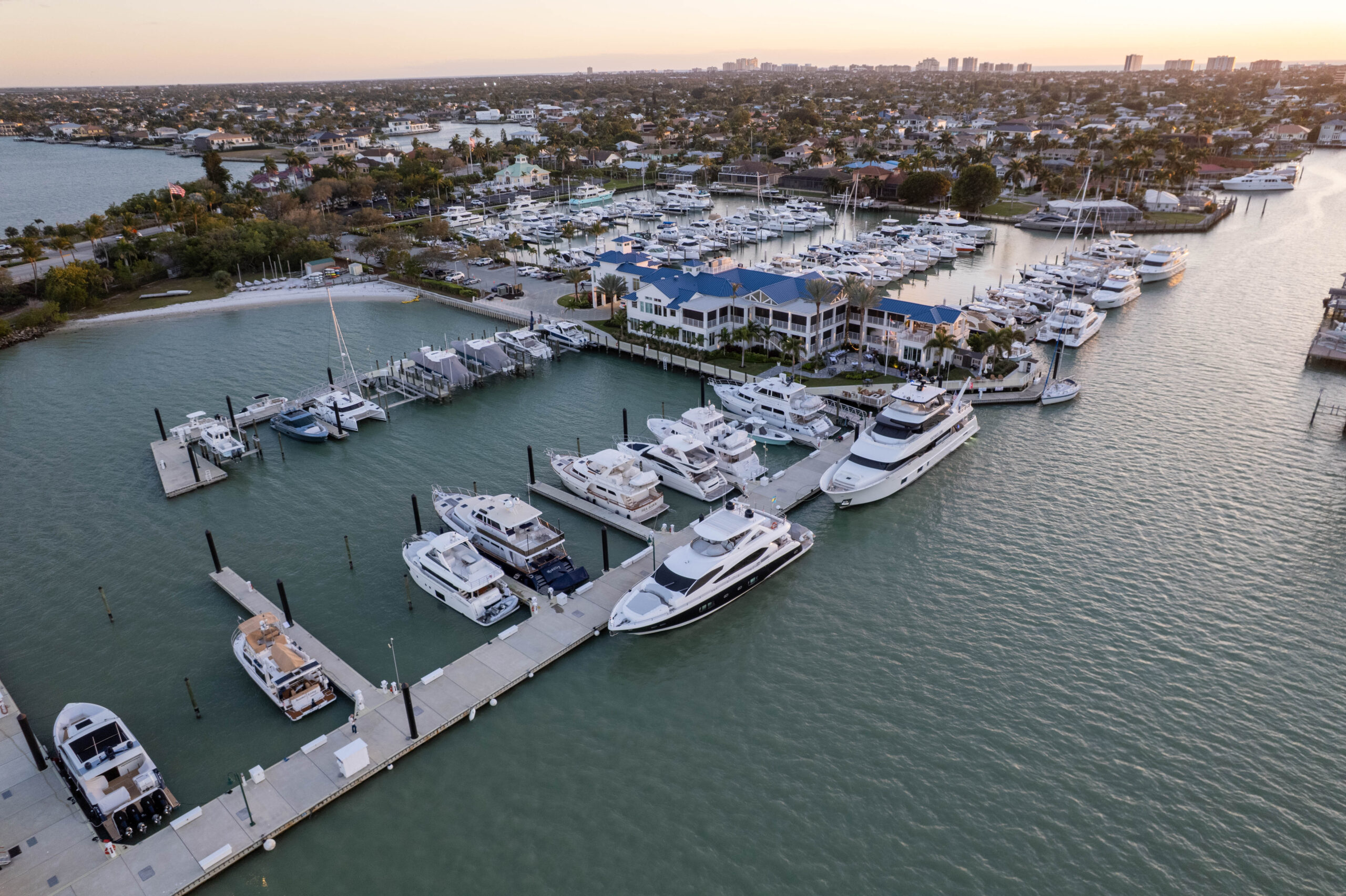
It was a lovely downwind run offshore to Marco Island and only got blustery when we turned east towards the wind into Capri Pass, which is the entrance into Marco Island. As we approached the Marco Island Yacht Club, we were met by a whole team to assist with our docking. They had assigned us to one of the largest slips in a marina full of huge slips and large yachts. Assisted Living looked like a midget among giants.


We explored the beautiful clubhouse and grounds, which had undergone a $13,000,000 renovation since our last visit. The club was having a buffet and live music that evening, but we opted to pass because we wanted to explore some on our bikes. We biked down Collier Blvd, and then followed the waterfront around Factory Bay, and eventually ended up at Snook Inn, a “chickee bar” on a point overlooking the water. (Chickee is a Seminole word for open air thatched hut). It was too chilly in the wind on their waterfront porch, so we took our snacks and drinks to go and biked back to the boat. After FaceTime with the grandkids, we watched a Netflix movie, and once again, were in bed by Looper midnight.

The next morning, we moved over to anchor in Factory Bay to work on some boat projects, and to stage for a predawn departure for the crossing to Key West. George worked on a solution for our noisy anchor bridle (not to be confused with noisy mooring lines). An anchor bridle is one long length of rope attached to both the port and starboard forward bow cleats, and in the middle the center point of the rope is hooked to the anchor chain. It is important to use two lines and not one because with one line the motion of the boat being blown from side to side can saw right through the center point of a single line. After attaching the bridle to the chain with two lines, you let out additional chain and the weight of the additional chain drooping down behind the bridle attachment point flattens the scope of the anchor chain, improving holding, reducing the shock load on the all-chain anchor rode, and theoretically reduces the boat’s swing from side to side. I say “theoretically” because compared to what we were accustomed to with our wide catamarans, this motorboat swings wildly. George applied some silicone spray and reoriented the anchor bridle chafe guards (old fire hose obtained from the Panama City Fire Department), and indeed, the movement and noise improved dramatically. Score One for MacGyver George!

Flush with victory, he moved on to replacing the electronic module on his bicycle. Another success! He now has the option for some electronic pedal assistance on our long bike rides. He did not have as much luck working on the Siren Marine monitoring system which he had installed just before we started the loop. Parts required to remotely monitor battery power and to monitor AC power input were defective so the company had sent us replacements for each that we had picked up during our trip home. George successfully installed the replacement part for the battery monitor, but the AC Power input was still not being seen by the system (which sort of defeats the purpose of a “monitoring” system). Oh well, on a boat it is always something. This too shall pass (cliché’, but true). We just hope it passes before the next time we are scheduled to leave the boat since the monitoring system is intended, among other things, to alert us remotely if the boat loses AC power while at a dock, giving us a fighting chance to get help before all the power-hungry amenities on the boat devour the house batteries. We’ve have since learned that Siren Marine sent us the wrong wiring diagram with the AC power monitor, so we have high hopes that we will get that part of the system online once George has time to rewire it.

George put together a video of our time in Naples and Marco Island with some pretty cool drone footage that we hope you will enjoy.
Comments
3 responses
Wow! Very interesting hearing of all the lessons required of boating full time. As you probably heard we are freezing here in Panama City Beach. 25 yesterday and 30 here this morning! Great narrative and videos! Stay safe.
Gary, we are currently in the Keys and it is even cold down here, and lots of big wind. Thanks for your comment. Never sure how much I should be explaining the technical aspects of boating, but wanted to make sure that the non-boaters can make sense of what I am writing.
Sound like you are having a great time exploring, and teaching us through your troubleshooting. What a team! Beautiful pictures