
On the morning of April 14th, we motored north on the North River in North Carolina, past Coinjack, into the North Landing River, then on to the Albemarle Sound and the Chesapeake Canal. There were several very low bridges (6’), but we were able to time our arrival to the scheduled openings. Just before the last low bridge at Centerville, we called ahead to our intended fuel stop and confirmed that we could stop to take on diesel. They told us to come on, but when we cleared the bridge and approached the fuel dock there was no room to pull in because the face of the dock was covered with small boats inconveniently spaced widely apart. There would have been plenty of room if one or two of the boats could be pulled one way or the other closer to an adjacent boat, but after checking with his boss while we circled in place, the employee at the fuel pump told us they couldn’t adjust any of the boats and we would have to go elsewhere for fuel. We had to continue on and buy fuel from the next marina which was fifty cents more per gallon. After fueling up, we crossed the channel and docked for the night at the free wall at the Great Bridge Bridge. And no, I did not accidentally repeat a word – the name really is “Great Bridge Bridge.” The name of the town was Great Bridge, Virginia, and someone creatively named the bridge after the town resulting in all future references to it coming across as a typo, and when mentioned in conversation the speaker appearing to stutter.
While George did some prep work for a meeting the following day, Chris walked a path along the ICW just beyond the Great Bridge Bridge to the Great Bridge Lock, which we would go through the next morning. We had not gone through a lock since 2023 when we took delivery of Assisted Living and brought her to Panama City from Florida’s east coast through Lake Okeechobee. It seemed like a good idea to watch a few boats going through the lock as a refresher and to learn how this particular lock worked (there are different systems utilized by the different locks). Wikipedia explains it best: “A lock is a water-filled chamber with gates at both ends that acts as an elevator for boats. It allows vessels to move between stretches of water at different elevations, overcoming geographical obstacles like hills or dams.” As locks go, the Great Bridge Lock is fairly minor since the elevation change is only two to three feet depending on the tide (there is a lock we will encounter on the Tombigbee Waterway that has an elevation change of 84 feet). The video George put together of our time in Virginia includes some photos taken while we were going through the Great Bridge lock.
Late that afternoon we heard from Ed and Alison on Love Me Fender. They were in the marina across the waterway where we had fueled and they had a rental car while they waited for some repairs to their boat. They picked us up and we all went to a Mexican restaurant for dinner to catch up one more time before we headed north and they headed home to Utah (they had completed their loop in North Carolina). It had been so fun to share part of our Loop experience with them, and we were sorry that our loops had not overlapped for a longer part of the journey.
The next morning, we were standing by for the 0800 opening of the Great Bridge Bridge and from there proceeded directly into the lock. It was likely the easiest lock we will encounter along the loop; such a nice way to ease into this next phase of the trip. The rest of the day was not as trouble free. What should have been a quick trip up to Norfolk, Virginia turned into an hours long slog as we were held up time and again by railroad bridges. Railroad bridges are typically held in an open position to allow vessels to pass, with the exception, of course, of the times when a train is expected. The railroad bridges on the way to Norfolk were automatically triggered and held closed whenever an oncoming train was sensed.
At the first railroad bridge we waited thirty minutes, dancing in circles with several sailboats that were also waiting to pass. At long last, an Amtrak train appeared and passed and the bridged opened for us. Shortly thereafter we were stopped by a second railroad bridge; queue the dance music with the same dance partners. After fifteen minutes we heard a train whistle in the distance, and eventually an extraordinarily long train began to cross, very, v-e-r-y slowly. With neither end of the train in view, the train completely stopped, where it sat across the bridge, motionless, while presumably somewhere in the distance tracks or train cars were added or rearranged. After another fifteen minutes the train’s progress resumed, and it finally cleared the bridge. Still, the bridge didn’t open. After some time, we heard in the distance the faint sound of another train approaching from the opposite direction. It took another ten minutes or so for thaat train to come into view. Because it is true that all things must pass, the final train of the day indeed passed and we continued to Norfolk.

As we approached Norfolk, we were captivated by the busy industrial activity blanketing the waterfront. Most impressive were naval vessels which were everywhere we looked and in various states of repair. Like an ant, we crawled past the aircraft carrier USS Eisenhower, and more than a dozen huge naval ships in drydock or tied up to massive bulkheads.


Several hours later than planned, we pulled into Waterside Marina in downtown Norfolk. We quickly threw together an overnight bag, made sure Assisted Living was secured and buttoned up at the dock, then grabbed a rental car to drive to Richmond, Virginia to visit two of our grandkids (and their wonderful parents :-).

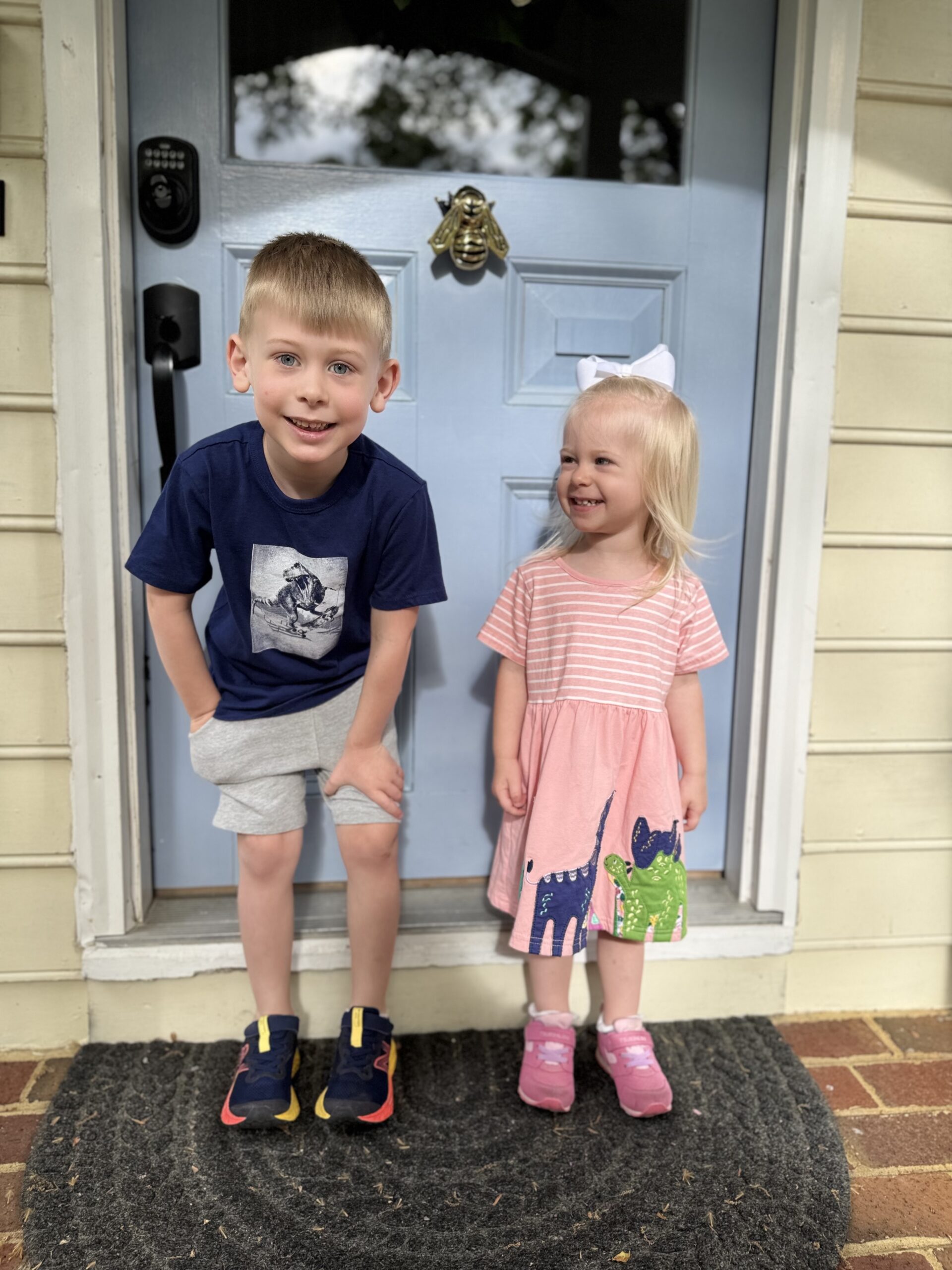
Holden (5 years old) and Caroline (2.5 years) are at such a sweet age; old enough to be excited about our visit, and young enough to want to spend every available moment playing with us. Holden, in sock feet on hardwood floors, demonstrated his prowess at a figure-four baseball slide which he recently learned in T-ball, and Caroline repeatedly ran back and forth showing us all the special “paw-jects” she recently completed in her Bumble Bee preschool class. Emilie and Ryan came home shortly after we arrived, and we all went to Holden’s T-ball game, where he again expertly demonstrated a four-figure baseball slide across home plate.


The next day, Mommy and Daddy, two busy doctors, were off to the hospital and we, Oma and Opa, were in charge for the day. It had been at least a year and a half since I had been to Holden’s preschool, so that morning when he realized I was tentative about where to go, he confidently offered directions and encouragement from his backseat car seat. “Go straight, Oma. Now turn here. No there. There ya’ go. Okay straight. Just a little further. Now turn, there it is. Just a little more.”). When we pulled in front of the drop off, he proclaimed, “There ya go, Oma, good job. Good job!” I felt so proud.
While Holden was at school, George, Caroline and I went to a Great Clips to get long overdue haircuts for both me and George. It felt like “cheating” on Fotula, my regular hairdresser of nearly thirty years, but desperate times call for desperate measures. Caroline alternated between exploratory walks outside with the grandparent who was not in the hairdresser’s chair, and standing on a chair looking over a divider carefully inspecting the hairdresser’s work. Eventually she asked to get her hair cut, but because I value my relationship with my daughter, I explained to her that her hair was too pretty to cut.
After retrieving Holden from school and putting Caroline down for a nap, Holden and I made cupcakes with sprinkles for his Daddy’s birthday (he specifically requested that we make cupcakes and that we not start until Caroline was down for a nap – he’s a planner, that one). While the cupcakes were baking, George and Holden went outside to work on Holden’s baseball skills. We are not sure exactly what George said that resonated with Holden, but he started hitting pitched balls, and by the time Ryan got home that night, Holden threw the ball to him like a bullet.


The next morning, Em and Ryan were out of the house long before we woke up, and as soon as the nanny arrived at 0800, we kissed and hugged on those babies and then headed back to the coast. Along the way we stopped in Yorktown, the site of a critical battle of the Revolutionary War. Before the battle, British General Cornwallis had established a stronghold at Yorktown from which the British could control the James River. The British had also taken control of New York and New York Harbor, and it was George Washington’s preference to attack the British in New York. Instead, our French ally, led by Comte de Rochambeau, thought the better plan was for the French fleet led by Comte de Grasse to sail up from the Caribbean and cut off the British forces in Yorktown clearing the way for a joint attack on the British Yorktown stronghold by the Washington and Rochambeau’s troups. He sent word requesting the French fleet to sail to Virginia, but before receiving confirmation, Rochambeau forced Washington’s hand by marching his troops south towards Yorktown, leaving Washington without the French reinforcements he would need to attack New York. Against his better judgement, and without knowing whether the French naval forces would arrive in time or be successful in cutting off the British navy at Yorktown, Washington and troops made the grueling march from New York to Virginia. Just before reaching Virginia, Washington received the news that indeed the French navy had arrived and prevailed and Cornwallis was now cut off from his supply lines.

The Battle of Yorktown was not so much a battle as a siege. The American and French forces dug in surrounding the British fortification, and once the outer defenses were overrun (thanks to French troops under Lafeyette, and American troops under the command of Alexander Hamilton), General Cornwallis knew holding the fortification without supply lines was an exercise in futility. He sent representatives to negotiate the British surrender to Washington and Rochambeau. In a move that has been noted in history as monumentally petty, Cornwallis himself did not appear at the surrender, but instead sent his underlings. Rather than accept the insult, Washington directed that the surrender be proffered to Washington’s underlings of similar rank to those from Britain. The Battle of Yorktown is viewed as a turning point in the Revolutionary War because after the unexpected defeat of the British at Yorktown, European powers decided that the American revolutionaries were worth betting on and provided support accordingly.
After we enjoyed the visitor’s center museum, a film and a Park Ranger lead tour, we drove along the route for a self-driving tour of the major battlefield sites and listened to the audio commentary. We stopped in downtown Yorktown for lunch at a riverfront restaurant and then spent the afternoon at the Revolutionary War Museum (with dozens of busloads of school children) where we explored the extensive exhibits and took in a cannon firing demonstration.


It was a full day, and we were exhausted as we headed back to Norfolk but had to make one additional stop before the marina. We found a grocery store and did a major reprovisioning, then returned to the marina where we pondered where in the heck we were going to store all the food we had just bought. With everything stowed, we were rewarded with a gorgeous sunset overlooking Norfolk that we enjoyed from the flybridge.

We decided that the pollen was following us up the east coast. George got up early to wash off the yellow coating that had settled onto every surface and into every crevice of the boat. By 0800 we were headed down the Elizabeth River, past the Portsmouth Container Port, the USCG station, Craney Island (US Navy Supply Center) and the Virginia Port Authority. The huge cargo ship activity was fascinating. We saw four submarines, another aircraft carrier and a range of navy ships, from destroyers, frigates and specialty ships. We entered Chesapeake Bay at its mouth and were in the mix with freighters and barges of all kinds and sizes.
Although we were initially headed for St. Charles, VA, upon further investigation we could not find a reasonable anchorage and the marinas were all very expense. We also checked the weather enroute and saw that the next day’s weather was forecast to be quite sporty, so we changed our trajectory and headed for a protected marina in Broad Creek at Deltaville, VA. We arrived slightly earlier than expected so we had to stand by while the marina shuffled some sailboats to make room for us. We pulled into our assigned spot alongside the outside dock at Norton’s. We were advised that there was only one good restaurant in town, The Table, so we made a reservation at the only time slot still available, 5:45 (blue-hair special, anyone?). The restaurant was several miles away, so we unloaded our trusty electric bikes and pedaled to dinner. All though the afternoon and that evening, wind gusts continued to climb, and by the time we biked back to the marina after dinner it was howling. It was a good thing we had paid attention to the route on the way to the restaurant, because on the way home we had no cell service, which meant no Google Maps directions. We were starting to realize just how remote Deltaville was. George reminded me that it was a good thing he had “an internal GPS” (he kind of does, at least compared to me).


The next two days the wind blew increasingly harder, and the temperature dropped. We huddled inside Assisted Living with the heater running. Chris tended to some business from Florida, while George worked on planning our upcoming stops, and the increasingly frustrating task of trying to arrange a Volvo tech to handle a warranty item and our routine maintenance during our upcoming planned stop in Annapolis. By the afternoon of April 20th, George was going stir crazy, so he biked over to the Deltaville Maritime Museum and Holly Point Nature Park, both of which were pleasant surprises. He learned that Chesapeake Bay was formed by a meteor strike that is responsible for the area’s unique geology and waterways.
Finally, on April 21st, we saw a break in the weather and were happy to move along. Traveling in the Chesapeake kept us on our toes as there was robust commercial traffic all around us. We wanted to see for ourselves Tangier Island, a tiny, remote community of watermen and women, located about 12 miles off the Virginia mainland, accessible only by boat or small plane. About 250 people currently call Tangier Island home. Most of the island’s inhabitants are related to the original 1700s settlors of the island, and its population has been dramatically shrinking and aging over the past few decades. Like its population, the land mass of Tangier Island is also shrinking. Due to severe coastal erosion and rising sea levels, Tangier Island has lost over two-thirds of its landmass since 1850. The island sits only about 3 to 4 feet above sea level, and some scientific models predict that the uplands could be almost entirely converted to wetlands by the 2030s to 2050s. One of the interesting things about the island is that because of its historic isolation, many long-time residents speak with a distinct accent that is often described as a lingering, 17th-century Elizabethan dialect. We had heard (and later confirmed) that islanders speak in a mix of modern and old dialect and consequently much of what they say cannot be understood by non-islanders.


We picked our way through the marshland on both sides of the narrow channel to the island, slowly gliding through some skinny, skinny water to approach the dilapidated pier of Park’s Marina (both words, an oxymoron). There was not quite enough room to fit Assisted Living across the face of the L-shaped pier, and so our bow and both anchors hung precariously over the stern of another sailboat docked on the long part of the L. We tied up, taking special care to use spring lines so the strong current would not push Assisted Living into the defenseless sailboat, that was open but currently unoccupied. We left a note on the sailboat with our phone number and a message to call us if they returned and needed us to move our boat so that they could depart. There was a sign on the pier advising that the dock was “self-serve” with instructions to leave cash in a metal box to be found on the house directly across from the pier. We put 40 bucks in an envelope and crammed it through the appropriate slot, then took off on our bikes to explore the island that at first glance appeared to be nearly deserted.


Except for temperature and topography, Tangier Island reminded me of many of the poorest Caribbean islands we visited by sailboat in the early 2000s. Most structures were in disrepair and surrounded by piles of junk and other random discards, and often with equipment and tool in various stages of decay strewn across the yards. Most businesses were shuttered or closed, but then again, it was a Sunday and seasonally prior to the time that most tourists visit the island. The Tangier Island Museum was closed, but whether that was due to the day of the week or the season, we could not tell. We rode down paved roads, turned to dirt roads, turned to sand roads, to view the beach on the south side of the island, then made our way back to the main settlement where we found one restaurant open. We decided to get our food to go, so we could move to another stop for the night. At Lorraine’s, we understood perfectly the young woman who graciously welcomed us and took our order, but when the kind woman from the kitchen delivered our take-out food and rang up our order, we couldn’t understand much of what she said. Not sure whether it was the old Elizabethan dialect, but it was lyrical words we had not heard before.
To depart Tangiers, we carefully navigated the narrow channel on the back side of the island, which was lined with crudely built waterman’s shacks, accessible only by water, serving as the dock for a waterman’s work boat, the storage for all his crabbing and fishing equipment, and in many cases, the waterman’s home. It was a short fifteen-minute ride across to Crisfeld, Maryland where we had reserved a slip at Somers Cove, a huge (huge!) but practically empty marina. We were starting to realize that not only were we ahead of the traditional “looper pack,” we were ahead of the tourist season for most of the places we visited. Big winds were headed our way, so we double checked our lines, cranked up the heater, and snuggled inside in preparation of the coming storm.


George has put together a video of our journey through Virginia that we hope you will enjoy.