
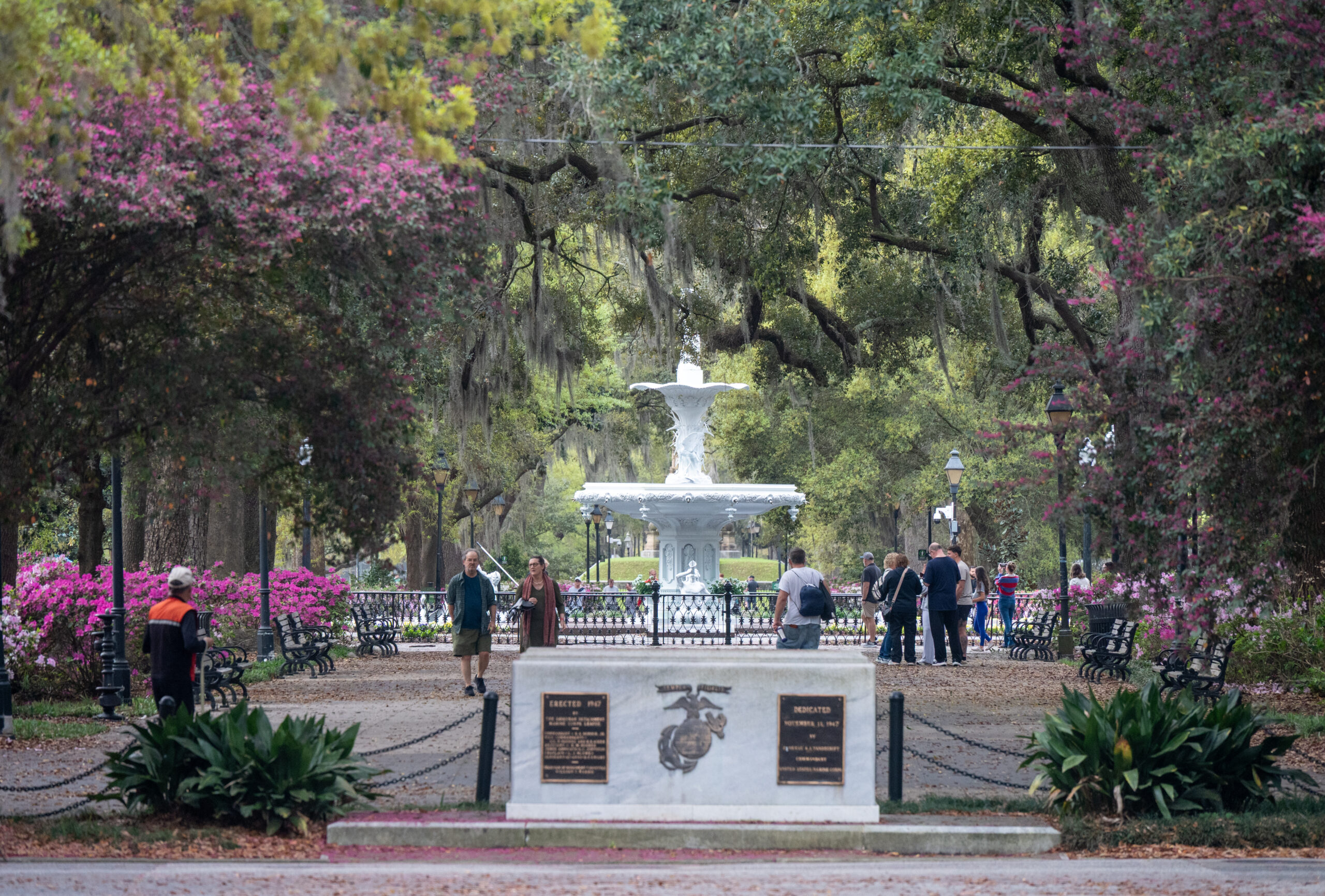
On to Savannah! We learned that our time in Savannah would coincide with its crazy St. Patrick’s Day celebrations. Unbeknownst to us, St. Paddy’s Day is one of the city’s biggest holidays. Unless we wanted to hang out with upwards of 800,000 drunk revelers that descend upon the city for the parade and parties, we were advised to steer clear of the city on March 17th. We also learned that Savannah marinas triple their already steep dockage rates for that entire week – ouch!
We were off the dock at Sunbury Crab Company by 0800, headed down the Medway River to join the ICW. In St. Catherine’s Sound, we took the Bear River against the north tide. We turned north through Hells Gate behind Racoon Key, where the depths reported on Aqua Map looked problematic. We radioed ahead to another looper we saw had recently passed through the area, and they reported they saw no issues, and indeed as we passed, we had at least 4’ below the props at the lowest point. We were in the Ogeechee River briefly before heading northwest on the Vernon River (Green Island Sound). The name of the river changed to Moon River, and then to the Skidaway River. We approached Isle of Hope Marina (just south of Savannah) at slack tide and easily docked to starboard.
After checking in, we borrowed the Marina’s courtesy car to go to a grocery store to reprovision. We spent the next few hours organizing all our purchases on the boat and moving things around to properly distribute the weight (Assisted Living is heavy to port, so we try to store as much as possible on her starboard side). We had a simple dinner onboard and while Chris worked on a business matter that seems to be consuming way too much of her time, George rested up for all the fun activities we had planned over the next few days with our friends, David and Diane Haubrich.
Dave and Diane are friends from Panama City who moved to Savannah several years ago. The next morning, they picked us up from the marina and we went into Savannah proper where they had arranged for the four of us to join a tour by Savannah Bike Tours. The Haubrich’s have done the same tour several times but think so highly of it that they take all their Savannah visitors on the tour. We were each assigned a comfy beach bike, and then leisurely pedaled through the historic district, visiting sixteen of its twenty-two squares, listening to stories about the city’s history and architecture. Our guide was top-notch; fun and informative, and set just the right pace. Historic Savannah was established in 1733 by its first colonial trustee, General James Oglethorpe, who was given free rein by King George II to design the city and its operations based on utopian principals. He envisioned the new colony as a second chance for the “worthy poor” and he recruited English debtors as its first settlors, with a promise that after a certain period of work the debtor would be free. Another of Oglethorpe’s utopian principals was no slavery in the colony. He also believed it was imperative to maintain good relations with the local Indian population. Unfortunately, Oglethorpe’s high ideals were discarded after ten years when Oglethorpe was recalled to England. The City’s unique design of twenty-two beautiful public squares laid out in a grid (with all homes and buildings facing a public square, with the building’s rear to the back of the buildings fronting the next square) has survived and remains part of Savannah’s charm to this day.


Historic Savannah has been meticulously preserved. We biked along Jones Avenue, the street that served as the homesite of the founding era’s most prosperous citizens, and according to our guide, that is where the phrase “keeping up with the Jones’” came from. We visited the Cathedral Basilica of St. John the Baptist, and admired its towering spires, Italian marble alters and elaborate stained glass. The streets of Savannah were oddly quiet, except for all the city workers and vendors setting up for the parade the next day, but the waters of the city fountains were already dyed green in honor of the upcoming celebration. It was the calm before the storm; our timing could not have been better to explore the city in relative peace.


After the morning’s bike tour, we had lunch at a lovely French patisserie, Paris Baguette. A weather front was expected to blow through that afternoon, so we selected a few indoor activities in the hopes of staying dry. We walked over to Savannah College of Art and Design (SCAD) and toured the impressive building (the first of over ninety buildings the college has acquired) and took in the SCAD Story, a Disney like animated production of the history of the school showcasing the creativity and graphic art genius of SCAD students. SCAD was established in the late1970s by a young elementary school art teacher who believed that traditional colleges were killing creativity. She talked her parents into spending their retirement savings on a derelict building in downtown Savannah, which at that time was completely blighted. The school has been phenomenally successful, both as one of the most prestigious art schools in the country, and as the single largest holder of real estate in Savannah. The college has been credited as the major force kick starting the revitalization of Savannah, reversing the City’s economic decline and transforming it into to the cultural and tourist destination we enjoy today.
We then hurried over to the American Prohibition Museum, as the leading edge of the front arrived and the first rain drops fell. Prohibition refers to the period from 1920 to 1933 when the 18th Amendment to the Constitution prohibited the production, transportation and sale of alcohol. The museum did a good job of explaining how Prohibition came about, mostly through exhibits of the posters and newspapers articles that were used to persuade Americans to vote to ratify the 18th Amendment. The movement to ban alcohol was initially an outgrowth of a temporary ban put in place during World War I to conserve grain for use in food production. Later, women’s groups took up the cause as a humanitarian effort to protect women from the scourges of husbands who would drink away the family paycheck and rend drunken violence on their helpless wives and children. There was also a strong undercurrent of anti-immigrant sentiment, particularly against Germans. Nevertheless, once passed, it was a spectacular failure, that left us with a legacy of organized crime. Fittingly, the tour of the museum concluded in a dark speakeasy where we enjoyed a craft cocktail, bourbon Old Fashioneds.


The Haubrich’s dropped us off at the boat for a brief rest, then picked us up and brought us to their home for a delicious dinner by Chefs Dave and Diane. They also introduced us to some new cocktail recipes (Dave is a master mixologist); we have added a new apéritif to our staples, Cappelleti (used in the brightest, freshest twist on a Manhattan, substituting Cappelleti and some lemon juice for part of the vermouth – oh lá lá). We called for a Lyft car to take us home, and on the drive back to the boat George had the most interesting conversation in Spanish with our Venezuelan driver who spoke no English.

The next morning it was 36 degrees with a wind chill on top of that (once again, we were failing miserably at “chasing 80 (degrees)”. George bundled up and biked over to tour the Wormsloe State Historic Site, a historic colonial plantation constructed with tabby (concrete made from shells, sand, water and lime).

Chris was tied up with work when he returned to the marina, so he borrowed the marina’s courtesy car to go exploring on his own. He checked out the civil war fort, Fort Pulaski. That evening, Dave and Diane joined us on Assisted Living for Chris’ homemade Chicken Tikka. It wasn’t as good as the gourmet meal they had prepared for us the night before, but it was great to spend more time together. We hope they will be able to catch up with us to spend some time with us on the boat on one of our upcoming loop legs.


The next morning the weather had warmed up — by two degrees – a whooping 38 degrees! George spent the day route planning, and Chris did legal work. Dave Haubrich came by to deliver a bottle of Cappelleti, which we had been unsuccessful in finding nearby (yay for summer Manhattans, or as we will now refer to them, “Savannahs”). We moved over to the fuel dock to fill our tanks and pump out our holding tank. Since we were leaving early the next morning, the marina asked us to spend the last night on the fuel dock so they could put an incoming boat into our former spot. George rinsed and scrubbed the boat while we had access to plentiful marina water, then relaxed by droning the sunset. We had leftovers for dinner, then in honor of the iconic Savannah home, Mercer House, where an infamous murder took place, capped off the evening with a showing of the movie “Midnight in the Garden of Good and Evil.” George has put together a fun video with highlights of this beautiful city and our time in Savannah.
The next morning, March 19th, we dressed warmly and were off the dock by 0700, headed for North Carolina!