

We left Florida Yacht Club on March 8th, and headed back through downtown Jacksonville, crossing under the maze of highway bridges, and marveling at the robust industry and the huge Jacksonville Port that lined the river. As we neared the Dames Point bridge, we were approached by a marine sheriff who advised that there had been reports of someone from the bridge going into the water. Although we were allowed to slowly pass under the bridge, we were asked to keep a sharp lookout for anyone in the water and to keep clear of the multiple rescue boats that were dragging across the river near the bridge looking for a body. We could see the jumper’s pickup truck stopped along the edge of the bridge overhead, with the door still open. It was a stark reminder that no matter our troubles, life is precious and by having the love of our family and friends, we are blessed beyond measure; just hold on to that, and everything else will eventually pass.

We were bound that day for Fernandina Beach, Florida, located on Amelia Island, some 46 miles from Jacksonville. We transited under ten bridges that day. As we neared the southern tip of Amelia Island to starboard, angry clouds and rain gathered to our port. George retreated from the flybridge to the inside helm as thunder and lightning overtook us. It rained hard for thirty minutes or so but slowed to a drizzle as we passed the first of two paper mills on our approach to the Fernandina Harbor Marina.

When we arrived at the marina, another boat was in our assigned spot, so we were redirected further down the lay along dock to a spot just in front of looper boat Love Me Tender. Ed and Allison on Love Me Tender were the loopers we passed on the St. Johns River who turned around when we warned them that the Astor Bridge was inoperable. We had previously spoken over the VHF and via the Nebo app, and it was great to finally meet them in person. That night, the four of us walked into town for dinner at a Mexican restaurant and had such a good time getting to know each other and trading stories that we practically shut the place down. They are from Utah, but bought a boat in New Bern, North Carolina, and started their loop there last summer. Ed is a recently retired physician, and we found that we had many things in common.

During the night, the paper mills located on both sides of the marina banged, hissed and released steam all night long. Trains ran continuously between the two mills. One thing we have noticed about northeast Florida is that no matter where you are, you are likely to hear trains running periodically all day and all night. The morning of March 9th was overcast and dreary. Chris had a business call that morning, so George took his bike to explore on his own. After a stop at the Amelia Island Welcome Center to get oriented, he visited the Amelia Island Museum of History. He relied on directions from Google Maps when trying to visit Fort Clinch, but unfortunately, he was directed to the Fort’s closed service entrance, requiring him to back track over three miles and then bike another three and half miles to enter the Fort. The worst part was that his electric bike was still malfunctioning, so he was left to manually pedal the bike which is much heavier than a normal bike due to the additional weight of the bike’s large lithium battery. Fort Clinch was constructed just before the War of 1812 and was instrumental during the Civil War. Because George never does anything the easy way, he biked the scenic route back to the boat, along Egan Creek, past several overlooks (he could see across to Georgia), then through downtown where he found an O’Reilly Auto Parts store to purchase an additional supply of oil for our generator. He schlepped his purchases back to the boat in his now very heavy backpack.


Later than afternoon, we were joined on the boat by Chris’ childhood friend, Scott Felts, who drove up from Ponte Vedra to visit with us again. Scott and his wife Nancy had met us in St. Augustine, and Scott had shared with us lots of local knowledge about northeast Florida and the St. Johns River. We were excited to share with him stories of our side trip down the St. Johns. Scott brought a lovely bottle of Pinot, which we enjoyed while relaxing on the flybridge. We eventually decided that food to soak up the wine would be a good idea, so walked into town for dinner at Ciao Italian Eatery. Scott decided to forego spending the night in our guest cabin, but since he travels frequently for business, said he may catch up with again at some point on the loop.
The next morning, George got up early to drone the sunrise but was driven back to the shelter of Assisted Living by the relentless “no-see-ums.” We would learn over the next few weeks, that those pesky bugs would be a constant irritant as we travelled through Georgia, South Carolina and North Carolina. We now keep our screens permanently in place and are grateful daily to our friend Jeane Harris of CB Sails who made awesome custom screens for us before we left Panama City.
Love Me Fender had moved on the day before to St. Mary’s, Georgia, so we planned to meet them there in time to visit the Submarine Museum on the morning of March 10th. We released our lines at 0900, and then ‘hit the gas’ so we would be there in time for the 10:00 opening of the museum. We found that 2500rpms with the trim tabs down gave us 17mph and fuel economy of 0.8mpg. We tied up at the free town dock in St. Mary’s, and while Chris stayed onboard to do some work, George met Ed at the museum. While at the dock, a former looper who now lives in St. Mary’s walked down to introduce himself and offer information and use of his car if we needed to do a grocery or supply run. The AGLCA flag we fly on the bow is a wonderful way to meet folks along the way, and the looper community – including prospective, current and former loopers – is a remarkable group.
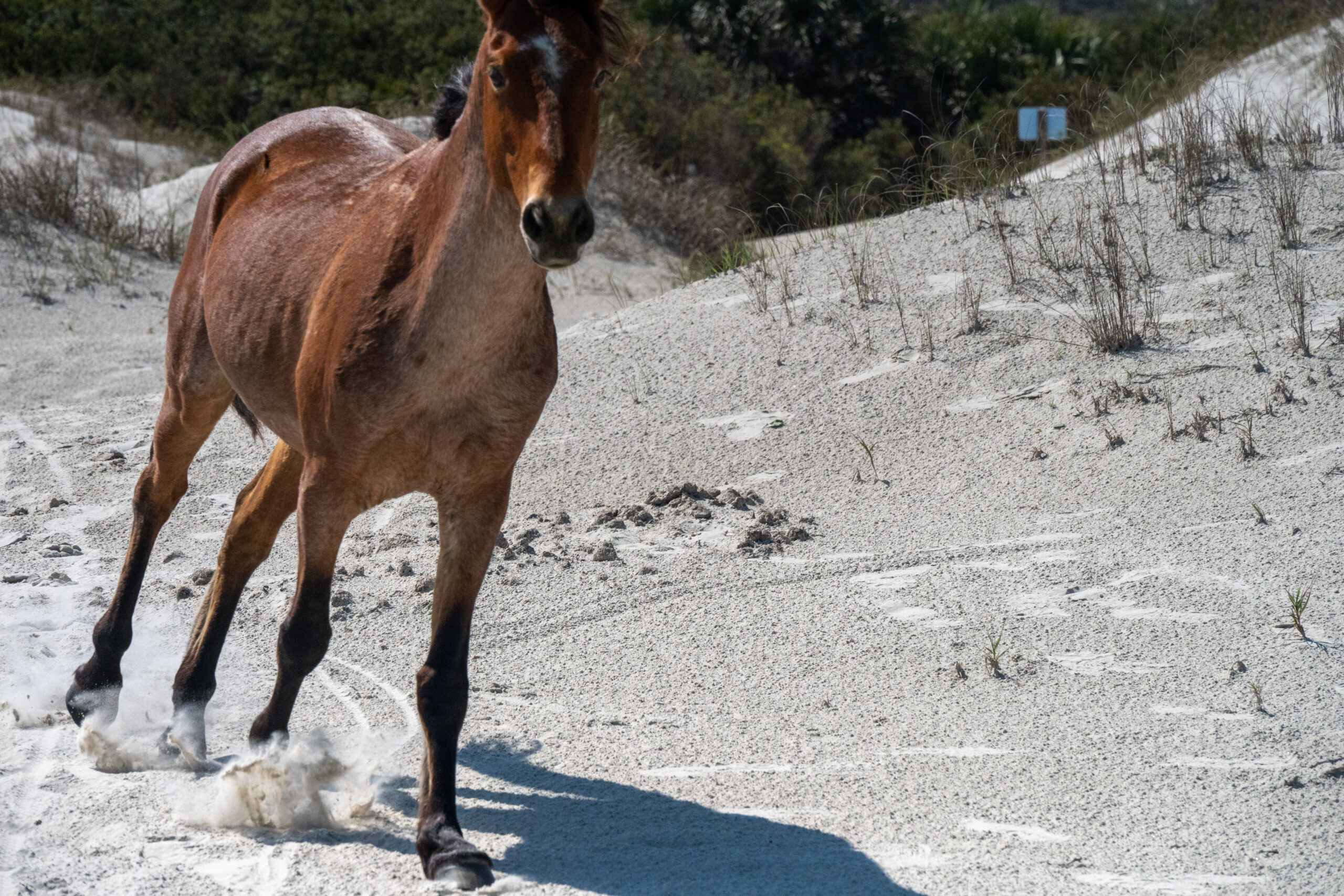
As we were leaving St. Mary’s, Ed pointed out the huge private dock next to the city marina; it was owned by owners of the Dodgers baseball team and his boat docked there was a replica of a presidential yacht. We proceeded to Cumberland Island, Georgia, where we anchored out. George used our dinghy to pick up Ed and Allison and the three of them went ashore while Chris stayed on Assisted Living immersed in pressing business matters. Cumberland Island is the site of a massive Carnegie estate, the centerpiece of which was the Dungeness Mansion, which is now only ruins from a catastrophic fire. However, several of the outbuildings have survived, and George and crew explored the pool/billards building, the stables, a kitchen, laundry, dormitories, and even an icehouse (ice was brought down in huge blocks from up north to provide refrigeration and cooling for the Carnegies and their many summer visitors). Wild horses now rule the island, and George was greeting by a galloping wild horse when he stepped off the trail leading to a beach. Of course, at the beach, George could not resist diving into the Atlantic Ocean, even though it was c-c-c-cold.


The next morning, both Chris and George had pressing business, so we hung out at anchor until mid-morning, then continued to the north end of Cumberland Island, where we collected Ed and Allison with our dinghy and went ashore to tour Plum Orchard, another Carnegie mansion but this one had been fully preserved and is now a state park. Plum Orchard had every modern (then) convenience and was beautifully appointed with its original furnishings. It had electric lighting and an annunciation system so that the servants could tend to every whim of the master and his guests. It was full of games, guns for hunting, a massive indoor pool, a squash court, riding stables, an early refrigeration system, an ice making machine, a generator and an elevator! The matriarch of the family, Carnegie’s widow (of Dungeness Mansion), had built the house for one of her nine children, but retained ownership so that she could control it for generations. After a docent led tour, we walked through the lovely gardens, then returned to our boats and headed further north to anchor at Jekyll Island. That evening, Allison and Ed joined us on Assisted Living for cocktails (for us) and mocktails (for them).


The night started with a gentle breeze, but later the direction shifted unexpectedly and picked up. George could tell that we were now swinging into shallower water and considering the nine-foot tide (there was about 4.5 more feet to drop), George became uneasy. We first tried shortening our anchor scope to see if that would put us into deeper water, but eventually George decided that we needed to pick up anchor and move to a deeper spot. Well, that was fun in the dead of night. We used a high-powered spotlight to see clear to cross the channel and then started motoring around and around and between ubiquitous crab pots and two other anchored boats to finally settle in a sliver of space between them that we thought offered the deepest alternative. You can see from our recorded track below that it was not easy to find a spot to drop the anchor. I don’t think either of us slept much after that.


The next morning, George attended a port board meeting via Zoom. By the time the meeting was over, the wind had strengthened even more. With the wind howling, we manhandled the flybridge Bimini closed and then hunkered down inside as dark clouds descended and a ferocious storm blew for hours. The rain rinsed the boat clean of salt, and the anchor held, so that was good. The bad news was that the wind shifted directions with the weather front and we once again swinging in an unexpected direction, with our stern now pointed to the nearby shore. The tide went out as the sun went down and at some point we realized that we weren’t swinging any more. That meant one thing — and it was not good — we were aground. We tried to shorten the anchor line and power up to get into deeper water, but the boat wouldn’t budge. We press on with dinner, but as you can imagine, our appetites were somewhat dampened.
We knew that the tide would start to come in again after midnight, so we went to bed and set alarms for each hour starting at 12:30 to get up and see how much progress we could make moving the boat further from shore with the incoming tide. At 12:30 we woke to see that we were floating, and by the 0130 alarm we noted that we were starting to swing normally. By 0230 the wind was still howling (that awful eerie sound) and the chain was under so much tension that it was catching on the top of our secondary anchor at the bow pulpit whenever the chain swept across the bow at the extreme end of each full swing of the boat from side to side. The grinding was unnerving, and ultimately, we climbed onto the bow in the dark to release the secondary anchor and then bring it up to secure on the deck to stop the god-awful noise. We had barely settled back into bed when a huge gust resulted in so much pressure on the anchor chain that the safety locking line broke with a loud bang, jerking additional chain out from the windlass. The brass safety hook from the safety line was still attached to the chain as it was pulled forward and so the hook jammed violently into the anchor shiv. The jam kept the anchor chain from paying out entirely, which was fortuitous indeed, because if it had not stopped the release of additional chain we would have ended up onshore. We needed to take the pressure off the jam and windlass, so we struggled in the dark to let out a small bit of additional chain attached to a rope bridle so we could take the pressure off the chain and the windlass and distribute it to a rope bridle attached to our two forward side cleats. It worked, but the pressure on the rope bridle was now so intense in the storm that it screeched loudly every time the wind load shifted from port to starboard. Desperate for a few hours of sleep, George moved to the guest cabin to get away from the horrible sounds of wrenching rope that was above our heads in our bow front master cabin. Our depth instruments were showing 4’ under our engines.
We knew that at sunrise that the tide would start to go out again (there are twice a day tides of up to nine feet each in this part of Georgia), so we were up just before daybreak to pull anchor up and head out. In that short time, the depth under our engines had gone from 4’ to 1.5’, so it was important we get out of Dodge! The wind was still blowing over 30 knots, so it was a real struggle to get the bridle in and the anchor up. We were so anxious to leave that we didn’t do our normal checks on the navigation route we had populated for our next destination. Instead of directing us through the ICW, the route on our plotter was taking us out to the Atlantic. We didn’t realize it until we had gone under the nearby bridge. We fumbled around trying to reset our route and somehow (with Chris at the helm) wandered out of the marked channel (and it is extremely shallow any place out the channel). We were alerted to our error over the VHF by a good Samaritan, a local commercial captain and so avoided another major mistake. Discombobulated, we retraced our path back through the bridge but then realized that we had been headed in the right direction in the first place, so back we went under the bridge. I am sure that the good Samaritan thought we were idiots, and he would not have been wrong. Fortunately, we and Assisted Living survived the multiple mishaps without any damage other than the obvious injury to our pride.
We were both happy to put Jekyll Island in our rear-view mirror. Honestly, if we ever pass this way again, I will take the Atlantic route and bypass the shallow tidal waters of Georgia. We passed St. Simons Island, and then Brunswick, Georgia. Although the channel is wide, due to the extreme tide and shallow depths, there is only a narrow sliver within which to navigate. We entered Doboy Sound and saw the Sapelo Lighthouse in the distance. We passed inland of Sapelo Island and Blackbeard Island on the Front River and drop anchor at the Crescent River. We were mid-tide, so calculated that another 2.5’ would come in, and then water depth would drop with the outgoing tide 4’ to end up at a depth 1.5’ less than the depth at the time of anchoring. We were starting to wrap our brains around this tide thing but were not big fans. Boating is much simpler in our home waters, where there is only one tide a day, and the change in depth is usually less than a foot.

We had a peaceful night at anchor and got some much-needed sleep. We woke up to thick fog but were not in any hurry to leave. We Face Timed with our oldest grandson and watched him open the present we had sent for his fifth birthday. Later we enjoyed videos of his first T-ball game of the season, and his birthday party later than afternoon. It is hard being away from family, and we are grateful for the technology that lets us feel like we are still part of their lives.


Before departing, we received a message on Nebo from another looper nearby that had an engine problem and was looking for a lidded 5-gallon bucket for an oil change. We offered to meet them to hand over one we had onboard, but before the rendezvous, they changed their mind and decided they would press on to Savannah on one engine and get some professional help.
Around midmorning we departed for the Sunbury Crab Company dock, a legendary looper stop in Sunbury, Georgia. Before the Revolutionary War, Sunbury was a prosperous town that rivaled nearby Savannah in port activity. After the British burned the town, the town suffered two hurricanes and yellow fever, decimations from which it never fully recovered. It has come back now as a bedroom community to Savannah. George went exploring by bike while Chris stayed on the boat to work. The roads were not paved, but the azaleas were in full bloom, and it was beautiful. He walked through the earthen ramparts of the revolutionary-era fort, and then the 1750’s cemetery, which are the only things which have survived from that part of the town’s history.


Dinner that night at Sunbury Crab Company was fabulous. George enjoyed a seafood extravaganza of crabs, shrimp and oysters. The oysters looked like they had been plucked off the dock as they were served as one large clump, each slightly steamed open. He managed to free each of them from their shells without cutting himself or sliding the entire mass off the table – it was quite a feat.
George put together a video of highlights of our departure from Jacksonville through our visit to Sunbury. Next up was Savannah, and that merited a video all on its own.