
On March 1st we left Florida Yacht Club in Jacksonville and headed south along the St. Johns River to explore central Florida. While not technically part of the loop, it is a common side trip, and one we highly recommend to other loopers. It was delightful traveling Florida’s interior by boat; the dramatic ‘Old Florida’ vegetation and abundant wildlife were a balm for the soul after traveling the heavily developed east coast of Florida.
About fifty miles south of Jacksonville, we pulled alongside the free town dock at the base of historic Palatka (note for other loopers: all the Palatka town dock slips are too small for the average size loop boat, but there was just enough lay along space for our 43’ boat between the outermost finger pier of the slips and the octagonal deck at the end of the town pier; we had to sneak around one piling, and we got a few funny looks while we were squeezing the boat into the open space, but it worked just fine for the few hours that we were in town). It was the town’s annual Azalea Festival, with live music, food trucks and vendors lining the waterfront and first few blocks of downtown. It was a beautiful sunny afternoon, so we parked our bikes and grabbed a beer to sip while we strolled through the festival. We detoured a few blocks over to look at Angel’s, which claims to be the oldest diner in Florida (and it looked like it, that’s for sure).


After we’d seen all there was to see at the festival, we rode our bikes several miles to Ravine Gardens State Park. The road through the park was surrounded by azaleas bursting with color, and it wound along the top of a deep ravine around and down to a lovely spring. There was a picturesque suspension bridge overhead. It was very peaceful.


When we returned to the boat, we wasted no time getting off the dock to head about a mile across the river to East Palatka where we planned to stay for the night at a legendary looper stop, Corky Bell’s. When we had listened to the AGLCA podcast on the St. Johns River side trip, they spoke so reverently of this destination that I thought it was a town that should not be missed. After searching valiantly for an embarrassingly long time, I finally figured out that it was simply a restaurant with a super long dock where you could stay for free if you had dinner at the restaurant (admittedly, my search efforts were also complicated by the fact that in the podcast I had heard “Porky Belles,” not Corky Bell’s).

When we arrived at Corky Bell’s, the place was hopping. The multi-level back decks cascading to the water were packed. Inside the restaurant was a mad house, and crowds waited at the front door just to put their names on the wait list. Apparently, we had arrived at the mecca of fried seafood in all central Florida (or quite possibly, one of the few restaurants along this very rural stretch of the river). We stood in line and dutifully retrieved our beeper after being told it was likely a 1.5 hour wait. No problem, we said, we’ll just wait on the boat. The sweet hostess explained that the signal might not reach us on the dock but promised to come find us when our table was ready. Ah, we were back to the land of southern hospitality.
While we waited on the boat, many of the folks walking the docks waiting for dinner stopped to chat. They were uniformly amused by the name of our boat and thought it was funny that it came about because George thought moving him to a motorboat w/gras akin to moving him into a nursing home.
Dinner was certainly memorable, more for the people watching than for the food. The waitresses were pretty much all older than me (either by age or simply by the heavy weight of life) and referred to all their patrons and their coworkers as “Hon.” It was charming and felt a bit like home. We were happy to find two items on the menu that were not fried. We were, however, a bit underdressed, as we were the only ones not sporting a baseball cap at the dinner table. We retired to the boat early, but George set an alarm to get up to see another Falcon rocket launch (we were heading south towards the Space Coast – yes, we were going backwards).

We woke up on March 2nd, socked in fog, and George barely waited for it to start lifting before heading down the St. Johns (places to go, people to see….wait, we are retired, right?) The trip down the river was initially surreal as we motored through the mist of the lifting fog. Depths were sometimes forty-five feet and then went to only nine feet. Ospreys were nested on the ATON markers along the way. At this point, the river was very wide and brown. The live oak trees were gorgeous, heavily draped in Spanish moss, and interspersed among the oaks were palm trees, everything so densely packed together that the vegetation looked impenetrable. Birds were everywhere. The shoreline on both sides was lined with what looked like large lily pads encroaching ten to twenty feet into the river. We learned later the lily pads were water hyacinths. George was checking out all the inlets and bayous as we passed, scouting for good anchoring spots for our return trip. Chris spent most of this leg consumed with the failure of the external hard drive used to store all our photos and videos.
We entered Lake George, traveling partway down its ten-mile length, then cut over to the west side to a spot to anchor outside of Silver Glen Springs. We anchored in relatively shallow water, then took the dinghy to the spring. The entrance to the spring was over a mile long, and immediately upon getting to the channel we noticed that the water went from brown to a translucent emerald green that shimmered as it rapidly flowed out. We saw groups of turtles sunning themselves on logs protruding from the water, often sharing their perch with a stately egret, whose stark white feathers were a dramatic contrast to the deep green backdrop of the swamp which enveloped it all. We saw a few alligators lurking on the shore (Chris decided then and there not to go swimming at the spring).
The channel opened to a nice basin that was crowded with small boats with large groups partying and enjoying the chest high crystal-clear water. We anchored the dinghy, and while Chris stretched out to sunbathe (and contemplated how she might restore some of our lost photos and videos), George snorkeled over to the roped area encompassing the spring. He dove down to inspect the deep crevice where the water bubbled and rushed out, occasionally spitting out broken shells and rocks dislodged from deep inside. The weather was a perfect 72 degrees, so lounged a bit on the dinghy just soaking it all in.


The wind had shifted and picked up while we were at the spring, and there was one pesky crab pot that was now annoyingly close to the boat. To avoid fouling our props, George hauled up the anchor without any assistance from our motors (which was a good thing, since the crab pot occasionally floated under our boat, but thankfully always popped out on the other side). We successfully moved out of crab pot range and completed our transit of Lake George, passing through a narrow channel on the south end of the lake that was defined on both sides by tall wooden walls; it was quite strange, and we are still not sure of its purpose. We re-entered the St. Johns River and continued to Morrison Creek, an oxbow just off the main river channel, where we dropped anchor for the night. George droned the sunset, while Chris made dinner, then we had a sweet goodnight call from our Virginia grandkids (lately, Caroline, who is two and a half, uses the excuse of “I need to tell Oma and Opa something” to put off going to bed; and we love it). We watched the full moonrise before retiring early. It had been a full day.

George got up at 0500 to photograph the lunar eclipse. The night before, Chris had initiated a First Aid program on his computer to try to repair the corrupt external hard drive, and though she had explained that it was critical that the sequence not be interrupted (“Whatever you do, don’t touch your computer!”), George decided that the light from the screen was interfering with his photos of the eclipse so he positioned a pillow to block the light. It interrupted the sequence, and pretty much all is now lost. It was not a happy morning on Assisted Living, for either captain or crew. In times like these, a 43’ boat can feel small, but since the only other person available to talk to these days is each other, there was nothing to do but get over it.
When it was fully light, we pulled anchor and headed south. First up was the Astor Bridge, with a stated clearance of 21’, below the 22’ minimum we need to clear without an opening. Thankfully, the tide board on the bridge indicated that actual clearance at that moment was 23’ (river levels had been well below normal due to a lack of rain). We really lucked out, because we learned from the bridge tender that the bridge was inoperable while repairs and upgrades to the bridge were ongoing (expected completed sometime summer of 2026). But for the lower-than-average rainfall, we would have been stuck north of the bridge and would have had to turn around, which is what unfortunately happened several days later to another looper we passed just north of the bridge on our way back north. After our good fortune sliding under the Astor Bridge, we continued south to the open T-dock at Hontoon State Park. The dock was abuzz with activity, with one small boat after another arriving every few minutes. We had happened upon the annual C-Dory rendezvous, and they had reserved every slip at the dock for these small trailerable boats. Lucky for us, we only fit on the outside T-head, which had not been reserved.

We checked in at the park office, and the park ranger gave us a thorough overview of the park and its many trails. We unloaded the bikes and went exploring. The island has two distinct ecosystems: in the center of the island is the Pine Flatwoods, which are tall pine trees and low shrubs; along the river and back channel is the Hammock, which consists of live oaks interspersed with palms. First, we rode away from the St. Johns River to the back of the island where the waterway that loops behind the island and connects to the St. Johns River is known as the Hontoon Dead River. The dead river was unspoiled and natural, almost prehistoric. We rode along trails of loose dirt and tree roots to find the Shell Mound, which is a huge mound of small shells along the dead river that had been dumped by the indigenous people who originally occupied the island. We rode further inland to marvel at the huge oak tree that is the center piece of Bear Tree Landing. Once again, our Lectric bikes were key to being able to fully enjoy and explore the new places we land. Many loopers debate whether to bring electric bikes or electric scooters, but for us it is clear that the right decision was the bikes.


When we got back to the boat, the C-Dory owners and crews were happily socializing up and down the docks. They were a friendly bunch, and we recognized several of the boats that had been at the dock with us a few nights before at Corky Bell’s. Some were past loopers, one was currently looping in segments, and several who hoped to do the loop in the future stopped by for a chat. We decided to stay tied to the T-dock for the night so we could explore the Hontoon Dead River the following morning by dinghy, and from there use a canal cut the park ranger told us about to take our dinghy for a visit to Blue Spring.
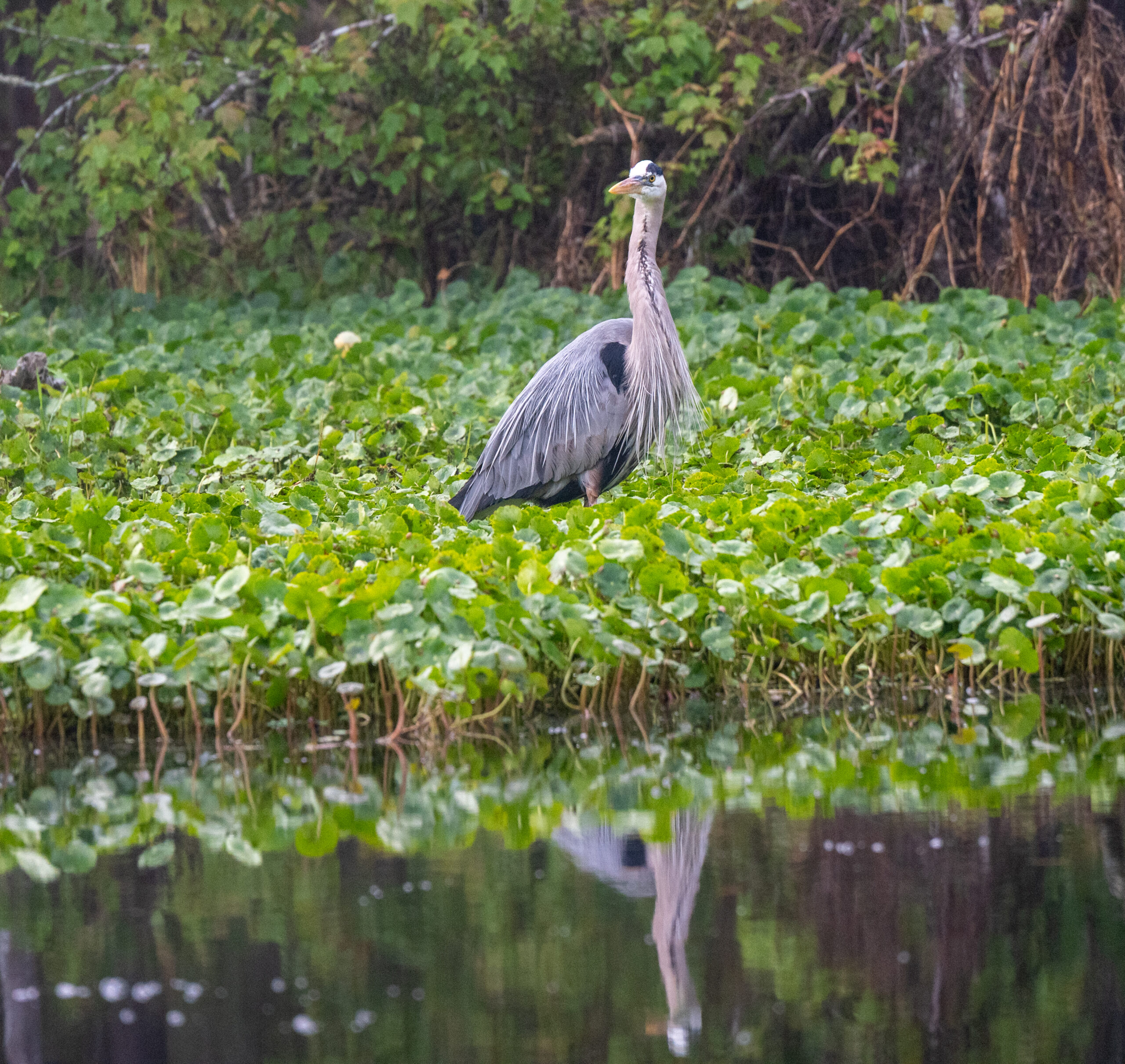
On the morning of March 4th, we launched the dinghy in the fog and made our way along the Hontoon Dead River. Although the fog eventually dissipated, it added a touch of eerie as we motored past the thick primordial vegetation. Blue herons and white egrets stared us down as we slipped past. We thought we saw an alligator or two lurking along the shoreline, and the only one we are certain we spied was belly up with four stiff limbs to the sky, a rather grotesque sight. We added vultures to the list of birds we identified. We eased by a few manatees and observed at least a dozen turtles.


We arrived at what we believed was the canal that would cut back to the St. Johns River and deliver us just south of Blue Spring. It was choked with lily pads, and we barely made it through the first mass before we had to stop and clear the motor. Looking ahead, the canal looked completely obstructed by floating hyacinth, so we reluctantly turned around and headed back to Assisted Living.
Blue Spring State Park, located about four miles south of Hontoon Island, is a crystal-clear collection of natural springs known for being the winter home of Florida manatees. It is a gem tucked into the interior of central Florida, approximately 25 miles south of Lake City, and 20 miles northwest of Gainesville. Roughly 102 million gallons of water flow out of Blue Spring into the St. Johns River every day. From mid-November to March, hundreds of manatees congregate in Blue Spring’s 72-degree spring run, seeking a respite from the cold. The park is the poster child of successful conservation efforts. In 1970, before Blue Spring State Park was established, researchers tracked only 14 manatees in the spring run. In 1972, the Florida Department of Environmental Protection purchased the park to start a manatee protection program. By 2023, over 700 manatees were tracked in the park.
It was not ideal to take the big boat to Blue Spring, but we hoped that we would be able to find someplace to anchor near the park for a short visit. As we approached Blue Spring, George was scolded over the VHF by a commercial captain who thought we were going too fast in the no wake zone that surrounds the park. Even though George had the boat in idle, a second commercial captain started screaming at us across the water, so George alternated shifting between idle and neutral (I think they didn’t like us being on their “turf”). Just past the park’s kayak launch, we tucked into a depression where the river split into several side channels and anchored in extremely shallow water just barely off the main channel. It took two tries to anchor because the wind and the current were not interacting as we thought it would. We waited on the boat for a while just to be sure that our anchor was secure and that we would not swing either too far into the channel, nor further into shallower water.
Finally satisfied, we took the dinghy to shore and were greeted by a half dozen turkey vultures, who stumbled and awkwardly flew to the tree branches as we approached. The springs at the park were lined by a wide wooden boardwalk connecting large overlooks, offering excellent views into the spring. There were only a few manatees, and we learned that the water temperature in the St. Johns had warmed up enough that the hundreds of manatees who had wintered there had recently dispersed to the river. The spring was still full of interesting fish – gar, perch and tarpon – which we easily observed through the stunningly clear water.


We didn’t linger long, both because of our precarious anchorage, and because our destination for the evening was the town of Sanford, some 14 miles to the south. As we traveled further south, we saw cypress trees mixed with palms. All around us small fishing boats zigged and zagged, and we constantly reduced our speed to keep our wake from rocking the many low gunnel fishing boats anchored or trolling along the river’s edge. George started counting and noted that almost every boat had six to eight fishing lines cast into the water at once. But in all those many boats, only one time did we see someone catch a fish, and it was little one, at that. As we approach Sanford, we had to wait for a train to cross the railway bridge before it could be opened to let us pass. We had reserved a slip at the Sanford Downtown Marina, and when we initially radioed in for instruction upon our arrival, our boat name caused a bit of confusion. Just catty corner to the marina is a five-story assisted living facility and initially the marina staff could not understand why the facility was calling in for instructions (a marine emergency at the nursing home, perhaps?). After realizing that the call was from our boat and not the facility, the marina directed us through a minefield of lily pads choking the fairway to the backside of the marina and our first ever covered dock slip. It looked like a tight fit, but the marina staff assured us that they had taken a tape measure to it that morning to confirm that we would fit under the roof. It was close.
There was one complication we hadn’t thought off. Since we were under cover, our Starlink dish did not have a clear view of the sky. We had gotten so used to flawless internet service that it no longer occurred to us just how our signal was received. Starlink is so good that we forget about it – more reliable and faster than our home internet service.
We got settled into our slip and threw in a load of laundry, then went to explore downtown Sanford which was located a block over from the marina. Before we left, the dockmaster told us that it was mainly breweries, and holy cow, he was right. We have never seen so many breweries packed into such a small area. They all seemed to be doing a brisk business on this sunny Wednesday afternoon. We strolled through the surrounding neighborhood appreciating the charming craftsman style homes, and then randomly chose one of the breweries for an afternoon refreshment.


We returned to the boat to dress for dinner and to switch our laundry, and that is when the excitement started. As I dumped the clothes from the washer into the dryer, the ugliest looking “bug,” about 3” round, suddenly plopped down next to her foot. With a visceral shudder I hot footed it out of the lower laundry room and hollered for George. He dashed to my rescue armed with a flyswatter, but when he started to scoop up the “bug,” it spread its pointy hairy wings and opened its little bat mouth! We quickly retrieved a second flyswatter and George trapped the little guy between the two. After the obligatory photo-op, George released the bat into the sky, while I secured all doors and windows, lest our visitor have some friends that might try to visit. We later spoke with folks who live on their boats at the marina and learned that bats are quite common there at dusk and that it was best to keep the boat buttoned up.
Sanford is home to a well-regarded German restaurant, Hollerbach’s, and we had luckily secured a reservation there for dinner. We learned later that reservations are a must at this very popular restaurant, even on a weeknight. It was as good as advertised, and we enjoyed authentic schnitzel and kasse spätzle. We never expected to find so many good German restaurants in Florida, and it has been a pleasant surprise for the man who spent a good bit of his formative years in Germany.
We departed Stanford early the next morning, March 5th, headed north for the return trip up the St. Johns River. It was a day of spectacular scenes of nature. We saw several bald eagles, one that plucked a fish from the river, and another that after a great deal of harassment stole a fish from an osprey.


We passed an alligator sunning itself on a downed tree. As we passed under the inoperable Astor bridge (aided by the lower-than-normal river level), we noticed many large boats tied up on either side of the bridge, obviously stranded by the inability to get through without a bridge opening. Shortly after passing under the bridge, we entered Lake George and noticed in the distance another looper boat headed southbound with an air draft that would likely prevent the boat from navigating under the inoperable Astor Bridge. We radioed ahead to warn them, and indeed they were too tall, so they turned around and followed up back north up the St. Johns. The wind had settled down, and we were making good time, so we continued north until late afternoon, when we negotiated a tight opening into a lovely and thankfully deep oxbow off the St. Johns where we anchored in a secluded and serene spot for the night.
The next morning, we left the big boat at anchor and took our dinghy to explore the Ocklawaha River. The locals aptly refer to this river as Jurassic Park. The morning light was superb in the lifting fog, and the undisturbed water mirrored the surrounding greenery and wildlife. The variety of birds was outstanding; Egrets, Ibis, Blue Herons, Light Herons, Osprey, to name a few.


After meandering along the river for miles, George did a speed run on the way back to the boat, getting the dinghy up on plane as we banked around the curves of the winding river. We made a slight detour as we approached our anchorage to check out nearby Welaka Spring. At the source of the spring, we saw scant bubbles so would not necessarily recommend to other loopers to go out of their way to see it, but since it was right around the corner from our beautiful anchorage, it was worth the few extra minutes.


We weighed anchor and continued north hoping to find a spot for the night at the Green Cove Springs free town dock. We arrived to find that all the slips but one were for small runabouts, and the only larger slip was taken by another trawler. They kindly offered to let us raft to their boat, but we decided that it would be better to drop anchor nearby and use our dinghy to visit town. It was Friday night and there was a lively waterfront festival underway. We wandered around the vendors, checked out the food trucks, and stopped to enjoy the live music. We took our food truck purchases back to the boat and it was the perfect venue and volume for listening to the bands while we ate dinner.
The next day, the first stop planned was just shy of Jacksonville at Doctor’s Lake to pick up fuel. As we passed under the bridge into the lake, we could not find the marina’s fuel pumps as they were not located where shown on the charts. We bobbed around for a while and when we could not get any response from hailing the marina on VHF, we finally called on the phone instead. The “dockmaster” was nice enough, but totally clueless in describing where the pumps were located; it seemed he did not understand the terms “port” and “starboard” (and failing that, also didn’t seem to understand “left” vs. “right”). We finally figured out that the pumps were likely located in a narrow channel just inside the bridge, and as we headed back there, we tried to get the dockmaster to tell us whether the diesel pump would be on our port or starboard side as we entered the channel. We could tell that the channel was too narrow for us to spin around once inside; heck, it was barely wide enough for us to maneuver past the other boats tied up alongside. For some unexplained reason, the gentleman would not answer that simple question, and just kept insisting that “it doesn’t matter, either side will work.” We could not make him understand that it definitely mattered to us; if the pumps were on port, we would prefer to back down the channel to put our starboard side next to the pump since that is where our boat’s fuel inlets are located. Also, all our lines and bumpers were positioned for a starboard tie. Instead of answering the basic question, he just kept telling us to come on in. We finally gave up and “came on in” bow first, and of course, the pump was on the port side, and as an added bonus, there were several small boats blocking the fuel dock. While we held in place, less than a foot from the boats tied up along the fairway, Chris ran a Chinese fire drill moving all our lines and bumpers from starboard to port and the marina eventually untied and repositioned the boats blocking the fuel dock. George had the pleasure of dragging the fuel hose across the back cockpit, then balancing on Assisted Living’s six-inch starboard freeboard, while bending over to pump fuel. Such fun.
After our adventures at the fuel pump, we continued north to return to Jacksonville and our second visit to the Florida Yacht Club. Since we previously knew we would be returning there, we had taken the opportunity to have parts and supplies shipped to the Club in the interim. Next to the weather, the biggest challenge of the loop is the logistics of resupplying. When we pulled in, we were greeted by Walker, the same friendly dockhand who had assisted us the week before. Walker is one of the club’s high school sailors and he works for the dockmaster part time. When he overheard George talking about getting an Uber to go to the Battery Store to pick up another replacement starter battery and return both battery cores, he kindly offered to drive George there and then bring him back to the club. It made the task of exchanging our two heavy starter batteries so much easier, and we were very grateful. Once again, we were so impressed with the young people at Florida Yacht Club. While George worked on installing the new battery, Chris retrieved all our Amazon packages. It was like Christmas, which at our age means the simple joys of receiving prescription refills, replacement computer parts, and hard to find good decaf coffee. That night we enjoyed another fine dinner at the Club restaurant and retired early to fortify ourselves for losing an hour in the spring adjustment to daylight savings time.
George created a video highlighting the spectacular scenery along the St. Johns River, and we hope that you will enjoy seeing this beautiful part of Florida.