
For days George had been studying the weather to identify the window that we would need to cross the next big body of water, Delaware Bay. He saw on the horizon that May 8th looked to have favorable conditions, so we decided to skip the remainder of our planned stops in the Chesapeake and head seventy-one miles directly to Delaware City, to stage for the crossing. We were up at 0545 the morning of May 7th to depart Baltimore Harbor, with the three other looper boats from the marina following closely behind. We were soon joined by a large freighter, all pointed towards the C&D Canal (the Chesapeake & Delaware Canal). We timed our departure and an intervening speed run (since Volvo says that every now and then you need to blow out the engines) to coordinate our arrival to the canal at flood tide. We entered the canal with an eastbound tide that would whisk us to Delaware City at 10mph while running at our standard 1250 RPM and boosting our fuel efficiency to near 3mpg. Usually at 1250 RPM our speed is between 7 and 8/mph and our fuel efficiency is just above 2mpg; flood tide for the win $$$.

When we arrived at the Delaware River we had to navigate around pipes from a dredge working in the river at the entrance to the original canal and the Delaware City Marina. We successfully navigated both the pipes and a shallow hump at the narrow entrance, then came alongside the side tie dock to starboard as directed by the marina staff. Staff then used the current to flip our boat to a portside tie so we would be pointed in the right direction for our departure from the marina. Once we’d checked in to the marina, George took off on the bike to explore town, while Chris stayed onboard to watch the show of the marina staff expertly bringing other boats into the dock in the very narrow canal. These guys were pros. George explored Delaware City’s main street, the waterfront, and a Black Union Soldiers Cemetery, but returned just in time for the marina’s 1600 briefing about crossing the Delaware Bay.

Boats depart from Delaware City and cross sixty miles through Delaware Bay to the northeastern tip where Delaware Bay meets the Atlantic Ocean, at the town of Cape May, New Jersey. This waterway is a congested commercial route, and with the prevailing winds funneling up the bay, a dangerous fetch can create hazardous waves. Strong tidal currents when opposed to the wind can also create nasty waves. And as a practical matter, fighting the current should be avoided regardless of wind direction because going against the current reduces speed and kills fuel efficiency. Oh, and we would be passing a nuclear power plant with a wide exclusion zone that prohibited any stopping or loitering. There are so many variables to understand and keep in mind. One of the excellent services provided by Delaware City Marina is a daily briefing which includes a review of forecast weather conditions and an explanation of how those conditions reverberate given the unique characteristics of Delaware Bay. Tim at Delaware City Marina generously studies the forecasts and provides a briefing to share his experienced and well-informed analysis with boaters looking to cross. We learned so much in the forty-minute briefing, and marveled again at how simple it is to boat in our home waters of St. Andrews Bay and the Gulf of Mexico. Based on the briefing, and our own review of the weather, conditions looked favorable to travel tomorrow from Delaware City to Cape May.
After the briefing we enjoyed visiting with Emily and Van Beck, who were docked in front of us in their Grand Banks 42, Shamrock. Emily and Van are not looping but have extensive experience boating up and down the northeast coast. We picked their brains and learned a lot. In anticipation of an early morning departure (needed to be up and out by 0600 to take advantage of the favorable tide), we retired early to the boat and dined on the extra pizza from St. Michaels that we had stashed in the freezer.
The next morning it was light by 0545 and we were the first boat out of the marina. The others soon followed. We headed into the Delaware River as the sun was rising. Traveling at 1300 RPM, we were making over 10 to 11 mph. On the approach to Cape May, we decided to stop for fuel at Miss Chris Marina before heading to our slip just around the corner at Utsch’s Marina. We entered Utsch’s Marina and said hello to all the boats we had met at the Delaware City Marina as we passed them motoring down the fairway to our slip. It was a regular reunion (Todd on SixWinds, Don and Barb on Current Obsession, Costa on Blessed, and Van and Emiliy on Shamrock). We were tied up and checked in by 1315.


Our dear friends from Panama City, Steve and Teresa Schelfhout, were in Philadelphia visiting their son and family and when we both realized we would be near each other, we made plans to meet. Steve and Teresa drove over to Cape May and arrived late that afternoon to the marina. It was wonderful to hug their necks and catch up with them. Soon, Emily and Van Beck joined us for happy hour, then we all walked a few blocks to dinner at Lucky Bones Backwater Grille, one of Emily and Van’s favorite restaurants from their many visits to Cape May. It was fabulous, and so fun to hang with both the Schelfhouts and the Becks. We ended the evening on Assisted Living with a looper toast of “Little Beers” which is a shot of a Spanish liqueur, Liquor 43, topped with a splash of cream; when the cream hits the amber colored liquor it foams up and looks like a mini beer.


The next morning the Schelfhouts picked us up in their rental car to drive to the southwest corner of Cape May to check out Sunset Beach and the wreck of the SS Atlantus, a World War I concrete freighter that broke loose from it mooring and became beached at Cape May in 1926. It still sits just offshore, slowly decaying. On the way back to town, we stopped at a WW II Lookout Tower that was used to triangulate U-Boats sightings for better accuracy when firing from coastal defense batteries, then we stopped and explored the Cape May Lighthouse. While Steve and George climbed to the top of the lighthouse, Chris and Teresa researched and booked an afternoon trolley tour of Cape May focused on its marvelous Victorian homes. We eventually worked our way back to the heart of the tourist center of Cape May, Washington street, which is now a dedicated pedestrian walkway with fountains, art installations, restaurants and shops. After a quick look around (no room on the boat to put anything new, so we were window shopping only), we hopped on the trolley to learn about the hundreds of beautifully preserved Victorian homes that are packed into Cape May. We wound through block after block with the trolley guide pointing out the differences in the features of Victorian architectural detail that could be used to identify particular time period during the Victorian era when a particular structure was built.


Moving away from the center of town, the trolley dropped us off at the Emlen Physick House for a tour of the interior of that remarkable Victorian estate which has been meticulously restored and is still furnished with most of its original furnishings and décor. The home was chock full of ostentatious details and overwhelming colors and patterns. There was no place for the eye to rest; it was quintessential Victorian.
After Physick House, we caught the trolley back to downtown, then stopped on our way back to the marina for an early dinner, again at Lucky Bones. They offer a huge menu, and both the service and food were so good the night before that we decided it would be hard to beat so why not return. After dinner, Steve and Teresa headed back to Philadelphia, and we met up with Emily and Van to talk about the weather forecast for our upcoming transit of the New Jersey coast. The weather forecast was not great, but it was also not horrible, and we all agreed that if we didn’t leave the following day we could end up stuck in Cape May for several more days or even up to a week.
For the transit up the New Jersey coast, we would be out in the Atlantic. Although there is an inland waterway through New Jersey, it is not part of the intracoastal system and is not federally maintained, consequently it is shallow and the controlled depths cannot be trusted. Another factor that had to be considered was that the New Jersey inlets along the Atlantic can be notoriously hazardous. All the guides and forums warn against attempting almost all the New Jersey inlets without local knowledge and in anything less than the most ideal weather conditions. The run from Cape May into New York harbor is roughly 145 miles, and so unless we wanted to run at over 15 mph for ten hours straight (uncomfortable and expensive), we would need to be prepared to duck into one of those inlets.
Emily and Van were on a schedule to get their boat, Shamrock, into the boatyard in Connecticut for some planned work, so they decided they would put the pedal to the metal and go all the way to Long Island the following day. We decided to depart the next day in the less-than-ideal weather, but planned only to go as far as Manasquan, NJ, or a shorter run to Atlantic City if the conditions in the Atlantic turned out to be unbearably rough.
The next morning, May 10th, George was up at 0545 to check the weather again and watch Shamrock and another boat, Blessed, depart. They each reported back that the pass out of Cape May was bumpy, but in the Atlantic the swells were 3’ – 4’, reasonably spaced but confused, and generally coming on the starboard aft quarter, which we thought would not be too horrible (oh, how our standards were slipping). When we went through the Cape May pass at 0700 the tide was going out in opposition to the swells coming in (meaning steep, confused waves), but once we turned northeast to move up the coast the swells were manageable. Manasquan was ninety-two miles from the Cape May pass, so we calculated that we needed to run at an average speed of 10mph to arrive before 1700. The Atlantic is deep quite close to shore so for the most part we were only a few miles offshore and could easily see the lively New Jersey beachfront, with its Ferris wheels, roller coasters, and beach houses packed tightly against one another like a box of well used crayons with a mismatched variety of shades and shapes.
By the time we passed Atlantic City, the swells had increased to 4’ – 6’. We saw waves breaking over Brigitine Shoal but moved further offshore to avoid it. North of us, Shamrock reported that they were socked in thick fog and had to reduce speed. By the time we reached Barnegat, the fog had lifted, but we could see breakers between the ATONs, so we headed further out to the vicinity of the “Safety” buoy (this coast was not for sissies). Unfortunately, the swells moved from our aft quarter to directly in front of us and were increasing with no real explanation as to why since the wind itself had not picked up.
As we approached Manasquan, we saw fog in the distance and unfortunately caught up with it. We sounded our air horn in accordance with nautical rules because our built in horn wouldn’t work properly in the damp weather (ironic, since sounding a fog horn signal in the event of foggy soggy weather is the primary safety reason for having a horn on a boat in the first place; I guess we are only meant to use ours to signal our displeasure to another boater, and even then only on a sunny day). The fog became patchy and thankfully cleared just as we made our final approach to the Manasquan inlet.

We saw huge waves breaking in the Manasquan pass. In anticipation of being pushed around, we powered up as we entered the inlet to make sure we had what we might need to control the boat. The large breaking swells pushed us from behind, but we mercifully surfed through the pass without incident (but not without a good bit of anxiety). We have a family joke (sort of a joke) that George always tries to kill me on Mother’s Day (lots of Mother’s Day boating stories over the years), and my 2026 Mother’s Day in Manasquan was no exception.
Captain Bill’s Landing and fuel dock was immediately to port after we cleared the pass, but even the fuel dock, where we were headed, surged as the swells wrapped around the corner from the pass. After a bouncy fill up, we motored a few slips over to our assigned spot for the night. Fighting the surge under the watchful eye of dozens of restaurant patrons eating on the back deck of the restaurant overlooking the dock, George backed Assisted Living to position us in a slip that was so narrow that we had a hard time squeezing bumpers between the boat and the pilings. A Canadian couple aboard Erie Feeling in the slip next to us generously helped us manage the lines in the strong surge. In addition to our regular docking lines, we pulled out every extra line stored on Assisted Living and strung a spider’s web to try to keep the boat safe and decrease the back-and-forth jerking motion. The spider’s web kept the boat from bashing into the pilings, but the cost was non-stop violent jerking against the lines as they fought the relentless surge (and it never let up – All. Night. Long.). You can see just how crazy it was in the video that George put together. After we were secured, Captain Bill himself came over to assure us that the swell was an anomaly that only happens once or twice a year. Lucky us.
The outdoor patio of the well-regarded restaurant, Red’s Lobster Pot, was located only a few feet from the stern of our slip. Chris had lost all appetite, but George called in an order for fried clams, which they delivered directly to our boat. As the sun went down, the restaurant closed, and our audience departed. We were exhausted but still wired from the day, so we converted the salon table to a lounge area (one of my favorite features of our boat), strapped ourselves in to keep from falling out from the jerking motion, and watched a silly show on Netflix as a mental pallet cleanser.
The next morning the weather looked okay for the 45-mile run to New York harbor, so with some trepidation about passing again through the Manasquan inlet, we headed out. Large swells were still crashing through the pass, making it a bit wild. At least this time, however, we were powering into the swells, rather than being pushed by them, so while it was not exactly fun, it wasn’t as bad as the evening before. As we began our progression up the coast, it was old home week for George, who grew up in New Jersey, went to college there, and has fond memories of many of the places we were passing as we moved closer to NYC (Sea Grit, where he went as a child, Belmar by the Beach, Avon by the Sea, Ocean Grove, and Asbury Park, with its boardwalk, convention center and home of the Boss, Mr. Springsteen). Despite being eleven days into May, the high temperature was only in the low fifties, and with no sun to add warmth and a north wind at 15 knots, it was cold. We kept the diesel heat running in the salon.

As we reached Long Branch, we began to see the skyscrapers of Manhattan! We scooted along Sandy Hook, NJ, turned west past Romer Shoal Light, and at last spotted the Verrazano-Narrows Bridge. It was such a thrill for George to be piloting his own boat under the iconic bridges of his youth. As expected, the waterways approaching and around NYC were heavily congested with huge commercial ships and ferries. We hugged the far-right side of the channel to stay out of the traffic. The high rises of Brooklyn came into view, as well as the south end of Manhattan.


We conversed over VHF with a container ship behind us that was headed to our starboard into Upper Bay Buttermilk Channel, and once we knew their path, we were able to cross the main channel in front of them to head to our anchorage near the Statute of Liberty. We paused to allow two Staten Island ferries to cross in front of us and recognized one as the Sandy Bottom, a ferry George had seen launched at Eastern Shipyards in Panama City a few years ago. We anchored directly behind the Statute of Liberty in about 9’ of water, with a spectacular view of the New York City skyline and Lady Liberty. Later that evening as it grew dark and the lights of the city came on, it was breathtaking.


At sunrise the next morning, George took off in the dinghy around the Statue of Liberty to try to capture a photo of the rising sun shining through the torch, the Lady “holding up the sun,” if you will. It worked somewhat, but not as well as he had hoped. Our only plan for the day was to circumnavigate the island of Manhattan, our own private Circle Line Cruise. As George engaged the windlass to pull up the anchor, he discovered to his great dismay that the replacement gypsy he had installed back in Annapolis (and was using for the first time this morning) was too small to engage the links of our chain. Since the links would not fit into the grooves of the gypsy, the windlass would not engage the chain to pull up the anchor. Lewmar had sent us the wrong one! Colossally disappointed, he slowly hauled up the chain and anchor by hand.

After George manhandled the anchor, we motored out towards the Battery at the south end of Manhattan. Ship traffic was heavy so in addition to keeping a sharp lookout both in front and behind us, we carefully monitored AIS and VHF channel 13 (the primary channel for inter ship communications in NY harbor). We crossed under the Brooklyn Bridge, Manhattan Bridge and Williamsburg Bridge, where we met an incoming tide pushing us into the East River. The East River split around Roosevelt Island near the United Nations building, but because we had reports that the UN was in session, we opted to go to the west to avoid possible delays or a security detour. We passed under the Queensboro and Roosevelt Island Bridges and continued up the Harlem River and then went under more 25’ bridges than we could keep track of. Where the Harlem River met the Hudson River, we encountered a low railroad swing bridge, but it opened for us without delay upon our request. As we headed south on the Hudson River with the imposing Palisades to our right, we crossed under the George Washington Bridge and passed the Met Cloisters and the Little Red Lighthouse. Continuing south, we passed Fort Lee on the New Jersey side of the Hudson, and Grant’s Tomb and Riverside Church on the New York side. A text came in from Jim Fanjoy who was tracking us on either AIS or Nebo, to let us know we were headed the wrong direction.
As we were nearing the completion of our circle around Manhattan, we spied Erie Feeling headed north, and that got us talking about whether we too should make use of the remaining daylight to move north of the City. The weather forecast was for a stout south wind in NYC, and that would make the anchorage behind the Statue of Liberty untenable, or at least terribly uncomfortable. As we neared Hoboken, NJ and passed the Upper East Side of Manhattan, we spun around after getting to Lower Manhattan and headed north. Jim Fanjoy was relieved.

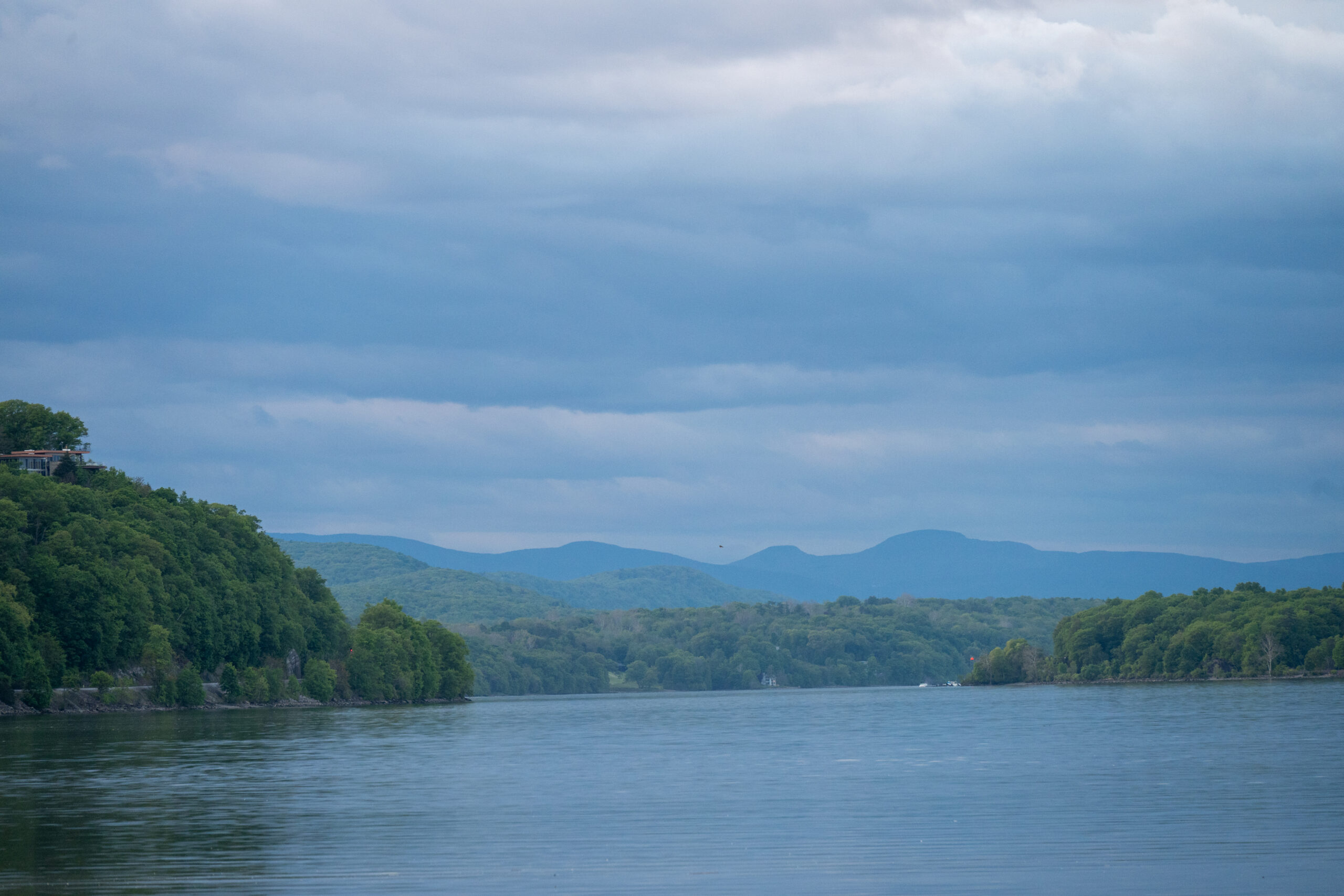
As we moved north of the City we were surrounded by remarkable natural beauty along both sides of the Hudson River. We were excited to pass under the old Tappen Zee Bridge, now named the Mario Cuomo Bridge. When our son Taylor first started working with Resolve Marine Group, he had spent seven months living in a Marriott working on the demolition of the old Tappen Zee Bridge. When the contractor who built the new bridge started to take down the old bridge, it had become unstable and they were concerned that it would damage the new bridge. Resolve was hired to safely take down and remove the old bridge. The plan was to do a controlled demolition to drop the old bridge span into the Hudson, where submerged chains between barges were positioned to gather and haul away the dropped span. The night before the demolition, Taylor explained to us that one of two things would happen the next day. Either the demo would go as planned and the span would drop in one big, beautiful piece, or things would not go as planned and he would spend the rest of his career retrieving a million toothpick-size pieces of the bridge from the Hudson River. Fortunately, it went as planned. For those who are interested, here is a link to the bridge coming down. It’s pretty cool.

After a beautiful trip upriver, passing one unique lighthouse after another, we arrived at an inlet to a protected anchorage at Haverstraw, NY. The reviews we had read of the anchorage warned of a submerged concrete wall just below the surface at the entrance to the anchorage. We tiptoed through the narrow inlet carefully and were rewarded with an anchorage with 360 degrees of wind protection.
The next morning it was cold and dreary with a light drizzle. Before attempting to haul anchor, George disassembled the windlass from our back up port anchor windlass so he could steal its gypsy to install on the starboard windlass which operates our main anchor. We needed our main anchor windlass to be functioning (hauling it by hand was not only a pain, but it would also be unreliable in an emergency). Fortunately, George was getting good at disassembling, swapping out and reassembling (just not a skill he had hoped to hone).
The swap was a success, and we pulled anchor without incident and headed just across the river to Croton-On-Hudson, NY, to Half Moon Bay Marina, where we had reserved a slip for several days. As soon as we were tied up, we were picked up from the marina by Enterprise. We had rented a car for the next two days. We headed immediately to nearby Croton Gorge, the site of the Croton Dam, created for the water supply for New York City. We saw it first from below, and the falls and crashing water was magnificent. We then drove around to view it from above, and it was equally impressive.


Next, we drove the winding highway above the Hudson River, crossed at the Bear Mountain Bridge and over to the U.S. Military Academy at West Point. We wandered through the visitors’ center and excellent museum while we waited for the start of our guided tour. The regular guide called in sick that day, but we lucked out because the substitute guide was a retired army special forces and West Point alum. The historical detail and personal insight he shared made for a fabulous tour. Some highlights were the stain glass windows in the West Point chapel, all gifts of various graduating classes, starting in 1915. Those classes then looked back and donated more stain glass windows in honor of the classes that came before them, until the entire chapel was full and each class was honored. Another highlight was seeing links from the enormous chain that was stretched across the Hudson at the site of West Point during the Revolutionary War to prevent the British from sailing their fleet up the Hudson.


Although we had a busy day of touring, we squeezed in some errands at the end of the day to take full advantage of having a rental car. Chris did a grocery store run to restock our food and drink supplies and got a pedicure to get her toenails painted orange in anticipation of attending the upcoming Princeton Reunion.
The next morning we did several loads of laundry and George troubleshot the windlass gypsy problem over the phone with Mike from Lewmar (it is not a good sign that the problem with Lewmar was so ongoing that George was on a first name basis with the Lewmar tech, and knew to ask for the guy by name). Mike from Lewmar was insistent that they make only one size metal gypsy and therefore Lewmar could not have sent us the wrong size. Finally, with the assistance of some action shots and other closeup photos from George’s iphone, Mike saw that the replacement gypsy was sized for a BBB chain (whatever that is; not standard in the USA), which was indeed smaller than the 5/16th G4 chain link size we had specified. It was nice to be vindicated, but no less frustrating since George had now dismantled and reassembled the gypsies three times (once to install the incorrectly provided BBB gypsy on the starboard windlass, a second time to disassemble the port windlass to steal its existing windlass and of course, install the BBB gypsy there so we were not without a backup of any kind, and a third time to install the stolen gypsy from the port windlass onto our main windlass at starboard). Mike from Lewmar promised to source the correct 5/16th chain gypsy and send it to us, but because he had no idea how long that would take (there was some mention of it needing to be sent from England), we decided the safest course was to have the part sent to Panama City and depending on when it arrived, we would have to figure out how to get it someplace along our then future route where we could retrieve it.
That afternoon we drove to Bear Mountain State Park, another spot that George remembered fondly from his youth. Driving the winding roads of the park was picturesque, but we were foiled in our attempts to visit George’s favorite spots in the park. We first tried to visit the Perkins Memorial Tower, but after working our way deep into the park found that the road to the final ascent was “Closed for Inclement Weather.” While it is true that it had drizzled lightly that morning, the afternoon was sunny with a bright blue sky, but a call to confirm that indeed the road was still closed was met with the cooperation and understanding that you would expect from a career government bureaucrat. Next, hoped to hike a famous trail in the park known as the TIMP, but when we tried to drive to the trailhead Google Maps insisted on directing us to use a road that was marked private, with an angry sign indicating that those who ventured further would likely be shot, or some such thing. Every attempt we made to reroute only brought us back to the same angry sign. After two or three circuitous drives only to end up at the same forbidden road, our hopes of ever hiking the TIMP were crushed and we headed back towards the marina. On the way back, we received a call from the wonderful team back in Panama City that is working to locate and remedy the water leak that is somewhere deep below the concrete foundation of our home someplace between the office bathroom and the kitchen island. The leak was not where the testing first indicated, so we were tasked with getting the specialized water leak detection company back out to try again.

The day was not a complete bust. Chris’ brother Steve was just down the road in Westchester County. Although he had moved from New York last summer, he was back in the area for a brief visit, and we drove over to meet him at the Westchester Country Club for dinner. We had a lovely dinner, and it was so nice to hear how Steve’s move to Austin had gone and also to get updates on all three of his sons, and on everyone’s favorite, his sweet granddaughter, Stevie.

The next day, May 15th, was an easy forty-four mile run north up the Hudson to Hyde Park. Along the way we passed several notable and interesting things: the Stony Point Lighthouse (barely visible through the spring tree foliage), the Indian Point Nuclear Power Plant, Bear Mountain Bridge (cool to pass under this massive bridge that we had crossed over the day before), and the U.S. Military Academy at West Point (as impressive by water as it was on land), and we got to watch huge military cargo planes executing “touch and goes” at Stewart Air National Guard Base. Another highlight was the slow pass we made by Pollepel Island, the site of the ruins of Bannerman Castle, an abandoned military surplus warehouse which was built to look like a Scottish fortress. As we passed Poughkeepsie, we passed under the Mid-Hudson Suspension Bridge, and then under an old rail bridge that was converted into a massive pedestrian bridge, the Walkway- over-the-Hudson. Shortly after passing the waterfront campus of Marist College, we docked at Hyde Park Marina.


I don’t know about you, but anything with ‘Hyde Park’ in the name brings to my mind luxury and grandeur. Well, the Hyde Park Marina was a bit of a misnomer. We were assigned a spot on the outside of the breakwater along the long fuel dock. Inside the protected breakwater the depth would only support small fishing boats. The gravel marina grounds were a mishmash of boats on trailers waiting to be launched for the season, a collection of miscellaneous rusted pieces and parts, and boats on stands in various stages of repair. The marina was isolated at the bottom of a hill with a sign on the road at the top of the hill that warned, “Private Road, Keep Out!” (maybe it’s a New York thing). Railroad tracks ran between the bottom of the hill and the entrance to the marina yard (which should have been a clue about the quality of sleep we could expect). But, the dockhands and the owner were helpful and kind, the marina showers and bathrooms were much nicer than the dilapidated building in which they were housed, the folks buzzing in and out on the small fishing boats were friendly, and it was good exercise to trudge up the hill several times a day to catch an Uber, so all in all, not a bad place to stay to explore the large number of interesting attractions in Hyde Park.
Against all odds, we had secured a last-minute reservation to dine that evening at the Culinary Institute of America, at their Italian restaurant, Caterina de Medici. The CIA was located just over a mile from the marina, so we decided to walk, but as we headed up the hill, one of the fishermen we had met at the fuel dock drove by and offered us a ride. We gladly accepted. For dinner, George had the stripped trout (amazing!), and Chris had one of the specials, a wood-fired peppers pizza (interesting and delicious – still not sure what kind of peppers, but wow). We washed it all down with a bottle of Cecchi Chianti Classico. We didn’t want to walk along the side of the highway in the dark, so after dinner we took an Uber back to the marina, but it took some coaxing to get our driver to go past the menacing sign and down the dark road to the bottom of the hill. He was visibly relieved as we crossed the train tracks and he saw the boats docked at the end of the pier.
We worried about how the boat would do on the outside breakwater exposed to the weather and wakes from the Hudson River, but the night was calm with minimal wind and boat traffic, so she did just fine. We can report that both passenger and freight train transport in upstate New York is absolutely thriving. Late into the night, and starting very early the next morning, passenger trains barreled by the marina, and since the entrance to the marina crossed the railroad track, we got the bonus of trains sounding a long warning signal as each approached the crossing. From just across the river, on the opposite bank, all night long the sound of freight trains rushing by traveled across the water. During the day, the sound of trains was in stereo.
The next day, even though we had walked past the top of the hill to the highway to try to avoid any problems, an unanticipated delay in our Uber pickup caused us to miss the first scheduled tour of the Franklin D. Roosevelt House, so we walked past F.D.R. House and spent a few hours touring the Franklin D. Roosevelt Presidential Library. It was the first presidential library in the US. It was the brainchild of F.D.R. himself, who meticulously planned both the physical structure housing the library, as well as many of the details of the exhibits. He personally oversaw the building’s construction on part of the original the Roosevelt estate that he had donated for that purpose. F.D.R. became president at a time when our country and the world was desperate to be pulled out of the crushing Great Depression. The breadth of landmark legislation and programs that were put in place in just his first one-hundred days in office is a testament to his astounding vision and tenacious drive, as well as to the unique circumstances of those times.


Within five days of taking office, he convinced Congress to pass the Emergency Banking Act, declaring a banking holiday closing all banks and reorganizing all failing banks. Roosevelt’s plan to shore up the banking system and restore it to public confidence worked; within short order, nearly half the deposits that had been withdrawn in the panic were redeposited. With a few months, Roosevelt and Congress passed the Glass-Steagall Act which, among other things, created the Federal Deposit Insurance Corporation (FDIC) so bank deposits were federally insured for the first time in history and the banks which were insured were subject to additional regulations and safeguards under the watchful eye of the FDIC.
Within four weeks of taking office, Roosevelt and Congress created the Civilian Conservation Corps, which hired over 250,000 previously unemployed young men for periods of six months each to plant trees, work on flood control, and fix up national parks. Later in the Hundred Days, F.D.R. signed on a much larger plan that allocated $3.3 billion to employ previously unemployed Americans in an array of government jobs across the country, eventually growing into the Works Progress Administration (WPA), the New Deal’s signature jobs program. A stunning number of the federal highways and dams that our country still utilizes today were built under the auspices of the WPA.
During the Hundred Days, Roosevelt’s administration enacted the first laws regulating the stock market. Many Americans believed that the Depression was caused by Wall Street’s dishonesty and corruption. The Truth-in-Securities Act (Securities Act of 1933) for the first time mandated disclosure of important information from issuers of any new securities, and the Glass-Steagall Act separated investment banking and savings banking to further insulate depository banks from speculative investing that many believed contributed to the banking crisis that incited the Great Depression.
Although major parts of Roosevelt’s National Industrial Recovery Act (the last major legislation of the Hundred Days) were struck down by the Supreme Court, several significant portions remained intact, including the provision that guaranteed workers the right to unionize.
Roosevelt’s Hundred Days signature legislation also included the seeds of the first social programs in the U.S. Within two weeks of Roosevelt taking office, Congress passed the Federal Emergency Relief Act, which established the Federal Emergency Relief Administration (FERA) to distribute $500 million through the state to provide direct aid and work-relief projects for the unemployed. It is hard for those of us who have lived in our country’s times of prosperity to fully grasp the dire circumstances that gripped the country at the time Roosevelt came to office. There were mass evictions from family homes, children were keeling over in school from malnutrition, and formerly middle-income families were foraging for food in garbage dumps. Before F.D.R. there was no social safety net – none. In 1935 during one of F.D.R.’s later terms, the concept of a social safety net was expanded with the creation of the Social Security Administration establishing a retirement savings program and a safety net for the aged, disabled and other vulnerable populations.
It was mind boggling to stroll through the presidential library and contemplate what might have been become of our country were it not for F.D.R.’s progressive leadership at that unique time in history.
We had barely made a dent in the massive number of exhibits when it was time for our tour of the F.D.R. House. The house was F.D.R.’s ancestral home overlooking the Hudson River, and it was common for him to conduct there what became known as “picnic diplomacy.” He and Eleanor often entertained foreign heads of state and business icons at their home, but home or not, they were always working towards their many causes and legislative goals. The home and all its original furnishings are a national park. While it is quite beautiful, it was clearly a family home (albeit, the home of a wealthy family). It has been beautifully preserved and is indeed a national treasure. After the home tour we returned to the Presidential Library for several more hours. When our minds became too frazzled to take in any more of the detailed history, we retired to a restaurant across the highway from the estate for a late lunch at La Catrina Mexican Restaurant.
After lunch, we grabbed an Uber back to the Culinary Institute of America for our scheduled tour of its waterfront campus and famed culinary programs. The CIA is an impressive institution. The tour began with a brief film about the college’s history and a primer on the difference between taste and flavor, followed by a hand-on tasting experience meant to heighten an appreciation of the distinction. Taste refers strictly to the sensory signals detected by your tongue, and is limited to five core profiles: sweet, salty, sour, bitter and umami. Taste happens on the tongue and in your mouth. Flavor, however, is a muti-sensory experience that combine taste with smell, texture and temperature. It is the balancing of the five core profiles, combined with the other multi-sensory inputs that elevate food to its finest. The mission at the CIA is to educate its student on the science, techniques and creativity that are the building blocks of the finest and most flavorful culinary experiences.
In the hands-on demonstration, we first tasted a jellybean with our noses pinched – no real flavor was detected. Next, we tasted the jellybean without pinching our noses – aww, it was cherry flavored (the flavor was only appreciated with the assistance of our nose – interesting). Then we experimented with bites of a grape, first alone, then dipped in sugar, then salt, next dipped in lime, then dipped in sriracha, and then various combinations. The moderator led us through a discussion of how the various attributes of each addition or combination created a different flavor. After the tasting experience, a student guided the group on a tour through campus, including peeks into its numerous kitchen labs. All meals served on campus are prepared by students, and one of the most beautiful spaces on campus was the student dining room, which had a bit of a Hogwarts vibe. After the tour, we strolled along the campus walkways along the shore and over to the “Egg” which is the student center where all the dishes prepared as part of a class are sold at a deep discount.
It was a beautiful day so we walked the mile back to our marina for a short rest before grabbing another Uber, this one to take us to Poughkeepsie to meet some family friends whose parents recently passed, and who were honoring their parents by working as volunteers at their German Club’s annual festival, Germania. They reached out when they saw that we were at a marina not too far from where they would be. We joined the three Schoenfeld daughters at the festival. Their mother, Lore, had for a time shared the multi-family home in Ohringen, Germany owned by George’s mother’s family where Oma grew up (George’s mom being the original Oma). Lore and Oma remained close and several years after Oma had immigrated to the US, Lore did as well. Oma and Opa had met another nice German boy, Karlheinz Schoenfeld (if I recall correctly, in their English language class). They invited Karlheinz to attend their wedding, and Oma instructed him to go pick up Lore whom Oma had decreed would be his date to the wedding. Everyone followed Oma’s orders (at least until I came along), and Karlheinz was no exception. Karlheinz and Lore later married and had four children. George and his sister have always referred to Karlheinz and Lore as Onkel Karl and Tante Lore, and the four Schoenfeld children were the closest things to cousins that George and his sister will ever have.

It was so nice to see Karen, Ellen and Andrea, and to reminisce over funny stories of all the parents (to be honest, most the stories revolved around Oma, who was quite a character). We enjoined German beers and brats. Ellen shared with us photos that her neighbor had taken of Assisted Living as we crossed New York Harbor! Ellen was at work when she noticed on our tracker that we were entering the harbor and would be passing near her apartment building in Brooklyn, so she arranged for her friend and neighbor to take photos as we went by. It was hard to wind the evening down, so we convinced them to return to Assisted Living for a tour and a nightcap. We will be thinking of them often as they work through the emotional task of closing out their parents’ affairs, but we were heartened to see how kind, close and supportive they all are to each other and their brother, Fred.


We spent the next morning researching our upcoming route and finalizing arrangements to leave the boat and travel back to New Jersey for George’s college reunion. That afternoon we took an Uber to the Vanderbilt Mansion. It was an amazing display of wealth, which the tour guide explained was the intention of the newly rich family attempting to break through the barriers of high society. Words cannot do it justice, so I will simply rely on including some photos of the decadent décor. The surrounding gardens were also lovely, as they terraced down to the water. We learned that most guests visiting the Vanderbilt family arrived by boat.


George was game for more touring, but Chris was overloaded, so while she returned to the boat, George ventured out again on his bike to look at Marist University and to ride over the Walkway-over-the-Hudson. George put together an excellent video covering our travels from Delaware through upstate New York, and the snippet of his ride over the Hudson on the pedestrian walkway makes me dizzy (it looks like he is about to run over walkers on the bridge, which is the type thing that can happen when he is unsupervised). That night, we were serenaded by long trains on both sides of the river, and by foghorns, motors and the crashing wakes of passing freighters and barges. The upper Hudson River is a busy place, indeed.

On the morning of May 18th, we eased off the dock at Hyde Park and headed north. The weather had warmed up enough that we were able to drive from the flybridge, and it was a delight to be out in the sun, cruising up the beautiful Hudson River, passing large homes poking out among the trees on the cliffs above the river. Just before 1030, we tied up to the Hudson Maritime Museum dock in Kingston, NY for /a quick visit to the museum. The museum was small, but interesting, with a focus on the steamships that plied the river until trains took over the trade. Steamship trade along the Hudson River had expanded rapidly with the opening of the Erie Canal in the early 1800s, and for nearly a century the river was the primary trade route connecting the east coast of the US with all of western New York, and even the cities on the Great Lakes.

After departing Kingston, the massive cliffs were slowly replaced by hills, although the Catskill Mountains remained prominent in the background to the west. We ducked into Catskill Creek and did a slow loop, checking out all the sailboats that had stopped there to have their masts removed in anticipation of a journey up the height restricted Erie Canal. It was a hive of activity, with sailboat masts and rigging being strapped down and secured lengthwise across the tops of boat from which they had been removed. We would meet some of these sailors as we transited the Erie Canal and even ran into one again on the Trent-Severn.
We settled into an anchorage, more of an indentation in the Hudson River, just beyond Catskill Creek and in the shadow of the Rip Van Winkle Bridge. With a current flowing at 2-3 knots, and wind blowing at around 18 knots in the same direction, it was clear when our anchor got a good bite, as the boat jerked to a stop when it reached the end of the 80’ of chain we had let out. Secure that we were not going anywhere, we enjoyed a peaceful night despite the wind whipping around us.


George was up at sunrise to take photos, then attend to some business from home, before we started the 32-mile journey to Albany, NY. The tide was running against us, so it was slow going, only 5.5 mph at our usual RMP of 1250. Eventually as the tide slowed down, we crept up to 6 – 6.5 mph, still painful. There was lots of debris flowing down river: logs and plant material, and every now and then something manmade. We had to keep a sharp lookout and hand steer to keep from hitting something that could damage our props. We had heard that the marshland bordering the river used to filter out the debris, but after the railroad tracks were constructed right at the river’s edge, the marshland had disappeared and now debris continues downriver unimpeded after a heavy rain.
We stopped in Castleton-on-Hudson at the Castleton Boat Club to fuel up (only $5.29/gal – ouch!!!!). The Boat Club was run solely by volunteers, but the guy who answered the phone (who was in Virginia on vacation), rustled up someone who was at the club working on their personal boat and he came over to fuel us up and let us pump out. As we departed the fuel dock, we earnestly videotaped the shoreline in hopes of capturing on video a glimpse of the former homes of a friend from Panama City who had messaged us that the home he grew up in, and one he later built himself, was located near there overlooking the river. We will be keeping our fingers crossed to find out if Google Maps pointed us to the right spot.


Five miles upriver we pulled into the Albany Yacht Club and slid in front of Flour Power. As we finished tying up, a brief shower with wind came in; perfect timing as we were happily ensconced inside the boat. It was hot and humid after the storm, so we turned on the air conditioning for the first time in months. We cleaned up and awaited the arrival of our friends, Norbert and Joni. We had met them several years ago at a conference for Seven Seas Cruising Association and immediately hit it off. Part of it may have been that Norbert is native German, but mostly it was because they love the water the way we do and when we met them, they had recently retired and were embarking on a multiyear adventure living on their catamaran sailboat, with several seasons in the Bahamas. We had kept in touch through the years and adventures and when Joni realized that we were headed to Albany near where they live, she offered to drive over and meet us. They came bearing a gift, some good, dense rye bread, that they picked up at their local farmer’s market. Auch du Lieber! They knew the way to a little German boy’s heart.

After years of living on their catamaran sailboat fulltime, they are now boat-less, and we understood how odd that feels. They were interested in our impressions of doing the Loop, and Joni seemed ready to jump back in to boating. Norbert may take some convincing. We tried to explain that Loop cruising along the US Coast (and we anticipate the same for Canada) is quite different from Bahamas cruising that they were most familiar with. For one thing, day to day life is just much easier, because food, supplies and parts are much more easily obtained and certainly more affordable. The logistics of keeping in touch and seeing friends and family is also more manageable. We’ve seen many friends along so many different parts of our Loop journey, whereas in the Bahamas, we would go months without seeing any of our old friends. On the Loop, there are less obstacles to getting away to travel back to see family and friends (always a plane, train or automobile easily accessible from just about every place on the Loop we have stopped so far); and although we have only left the boat a few times so far, we know that if we ever need to, stashing the boat in a marina and traveling home is always an option. In the Bahamas, traveling home was cost prohibitive, logistically untenable, and just not realistic for us. At times, during our seasons in the Bahamas, I felt completely disconnected from our lives at home. How you fill your days on the Loop is also completely different than in the Bahamas. Instead of the long, isolated stretches away from first world civilization that we both associated with Bahamas cruising, cruising the Loop is a way to take your home along with you while you explore a wide variety of charming towns and interesting cities and do it in a way we all love best, by water. For me, at least, after a while, all the stops in the Bahamas started to feel a bit the same (stunningly beautiful, but still, all similar). With Loop cruising, there is something new and different every day, and the various regions of the country and Canada are so disparate that each new region is a markedly different experience from the prior region. I have never been bored on the Loop.
Joni had an early flight to catch the next morning, so we said our good-byes with promises to keep in touch, and open invitations to visit one another. We would love to see them sometime in north Florida. It would be fun to show them the spectacular boating in our deep bay, and the sugar white beaches of Shell Island and Crooked Island. Shortly after they departed, Norbert returned to the boat. When leaving the dock, he had found a wad of fifty-dollar bills laying on the dock. He thought it likely belonged to one of the two big yachts docked behind us, but no one was home at either when he knocked. He handed off the money to us in the hopes that we would be able to return it to its rightful owner. As we hung out on the boat that evening, George kept an eye on the yachts behind us and when he saw a couple return to Flour Power, he walked over and asked if perchance they had lost anything. Yep, they said, a whole bunch of fifty-dollar bills must have dropped out of Michelle’s pocket when she was leaving the boat. George told them they were in luck; the funds had been recovered by our friends and if they wanted to follow him back to our boat, he would be happy to hand it over. When they came to the boat, we returned the money and exchanged boat cards. They were headed home to Lake Superior where they keep their boat. Michelle tried to give part of the money back to George, but of course, he refused to take it.

We spent the rest of that evening, and the following day, getting the boat ready for us to be away for four days and preparing for our guests from Panama City that would arrive the morning after we returned and would be with us for close to a month. We made a complete inventory of our food and drink supplies so we would know what we needed to buy when we returned in a few days, and we defrosted the refrigerators so there would be someplace to put everything we planned to buy. We cleaned Assisted Living inside and out; the outside being a particular chore because the boat was covered with a stubborn film of yellow pollen (and George suffered terribly for it). We folded down the flybridge Bimini and secured it in its cover, and stowed any loose items and equipment so nothing would blow off or “walk away” while we were gone. The biggest job was cleaning out the guest cabin, which had morphed into a catch-all storage room while it was just the two of us on the boat. We worked to find a place to stash everything, and most importantly, made a note in our storage inventory spreadsheet so we would be able to find the relocated items later.
Finally, from the bowels of the storage compartment under the mattress under our bed, we unearthed our suitcase and a bin of Princeton reunion clothes that we had accumulated over past college reunions. Starting with the year they graduate, and every five years thereafter, Princeton puts on a major class reunion for alums of that class. For each reunion, included in registration for all those attending (classmate, spouses, family members, etc) is a full assortment of reunion clothing – t-shirts, camp shirts, polo shirts, beer jackets (a casual jacket), hats, sunglasses, umbrellas, bags, and one year when the kids were little, even a pin on tiger tail (the school mascot is Princeton Tigers). At the 25th Reunion, the reunion clothing included an official “class jacket” which in the case of George’s Class of 1981 was a tailored sports coat lined with a silky fabric on which was printed a list of every member of the class. George had managed to attend every five-year reunion since the beginning, and starting with the ten-year reunion, Chris was in the picture and attended every reunion from there on out (when the 40th was canceled for Covid, we invited seven of his buddies and their wives to join us in Panama City for a private reunion, and we even made up costumes for that one). To say that we had an overabundance of ridiculous Princeton garb would be an understatement, and even with the limited space on Assisted Living, we had hauled it around for the past five months in anticipation of the 45th Reunion.
I was down in the master cabin packing that morning while George was in the salon on a zoom meeting when George sharply said, “Chris, come up here!” I couldn’t imagine what was so urgent, but when I popped my head out of the master cabin, I saw the Sheriff (not a patrolman, the actual county Sheriff), in full dress gear, big hat, gun and all, standing on the dock knocking on our hull. What in the world had we done wrong? It turned out that the Albany Yacht Club was hosting a press conference with the Governor and the NY State Sherriff’s Association and the head of that Association, Sheriff Juan Figueroa, spied our boat down on the dock and came to check it out. Sherriff Figueroa was also the proud owner of a Ranger Tug and he had never seen one as large as ours. We had a nice chat about boats and boating and by the end of our conversation he gave me his card, on which he wrote his personal cell phone number, and generously told me not to hesitate to call him if we ran into any issue while we were in New York. He said he would help in any way he could. He also gave me his NYSSA challenge coin, which was pretty cool.
While George continued securing Assisted Living, I left for the airport to pick up our rental car. On the way back to the boat, I took a detour to a TJ Maxx and a Walmart to try to find some black or orange items of clothing that would keep us warm. Usually it is hot, hot, hot for Reunions, and all the Reunion gear reflected that, but his year it was predicted to be downright cold. The forecast was also for rain all weekend, and even though that was typical for the Class of ‘81 Reunions (their tongue in cheek class reunion motto was “’81 Reigns”), this year it looked like it might monsoon, so I picked up some cheap rubber galoshes. I was too old and grumpy to suffer for fashion or tradition. It was more important to me to be warm, dry and comfortable.
We will not bore you with a blow-by-blow description of our time at Reunions but suffice it to say we had a blast reconnecting with George’s friends from college, attending interesting lectures on cutting edge topics by prominent leaders in the field, and, as always, the party was over the top. George has put together a separate fun video of some of the highlights of his 45th Princeton Reunion; a unique event that you’ve got to see to believe.
And don’t forget to check out the video that George created of highlights of our loop segment from Delaware through Albany, NY.