
We had arrived the afternoon before to the practically empty Somers Cove Marina in Crisfield, Maryland to take shelter from a windy and cold front. The following morning if was still blowing, but we wanted to explore the town anyway, so we took off on our bikes. Our first stop was at a traditional waterman’s café to try out the local specialty, scrapple. We had been advised to order it crispy and from all accounts it sounded like it was a cross between a hot dog (unidentified leftover parts) and a sausage patty (pork parts, best consumed crispy). When the waitress delivered our scrapple, I asked her to explain what was in it, and she quickly replied, “Honey, you don’t want to know.” That put a damper on my enthusiasm, but I tried it anyway and immediately regretted it. George’s culinary tolerance is much wider than mine (as in his has no boundaries at all), so he choked his down because he didn’t want to offend the locals, then waited for the gallbladder attack he believed would inevitably follow.


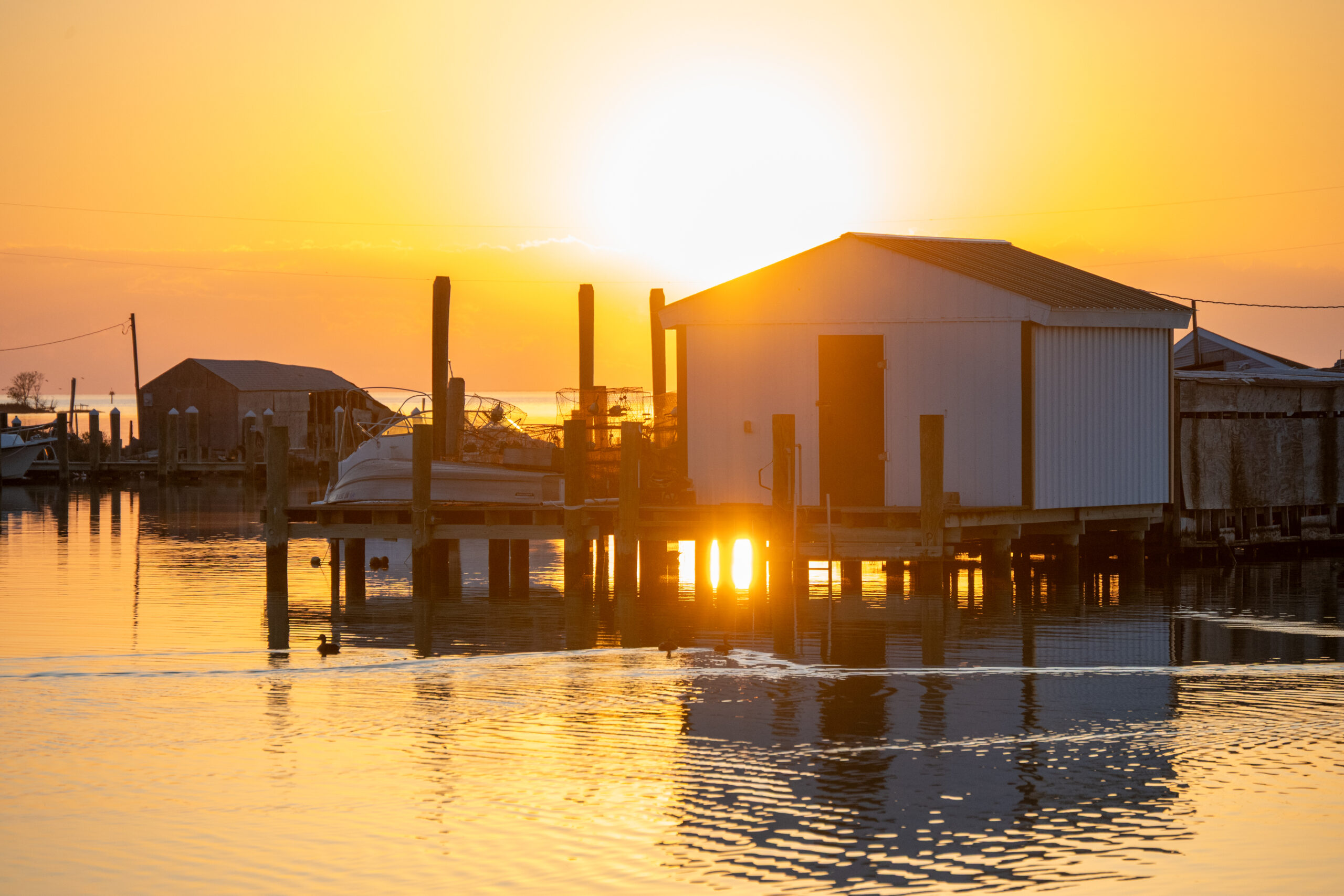
We biked through downtown Crisfield, but most businesses and all attractions were closed. Many were not slated to open until June 1. On a suggestion from the visitor’s center/chamber of commerce office, we headed away from town to a desolate area along the water where the local watermen keep their boats at watermen huts, or shacks. George peeked into one that specialized in soft shell crabs, and the waterman generously gave him a quick tour and explained their process. While there, he saw a crab molt to become a soft-shell crab. A molted crab must be quickly processed; if left alone, the crab would again develop a hard shell – so timing of the crab’s demise (i.e., processing) must be carefully managed.


We ended our tour with an unsuccessful hunt for Smith Island Cake, which is the official dessert of Maryland, and is baked in Crisfield for commercial distribution. We found the bakery, but they were not yet open for the season for tours and sales. Smith Island Cake is comprised of 8 to 12 ultra-thin layers of golden yellow cake, each layer separated by rich chocolate fudge icing. The thin layers historically prevented the cake from drying out during the long fishing trips common among the Smith Island watermen. We were headed to Smith Island next, so consoled ourselves with the thought that we might be able to taste the iconic cake on the island where it originated.
By the time we retraced our steps through downtown Crisfield and back to the marina, the wind had started to come down, so we readied Assisted Living for departure and headed back across Tangier Sound in Chesapeake Bay. It rained lightly as we approached the shallow channel into the village of Ewell on Smith Island, Maryland.


Smith Island, like Tangiers Island in Virginia, is a unique island community of watermen families primarily populated by descendants of the original settlers from the 1700s. We had planned to go into a slip at 3 Knots Marine, but it was obvious that the slip would be too shallow for our draft. We pressed on to Ruke Memorial Dock and slipped in between a ferry boat and a fishing boat. We were unsure if we would be allowed to stay there, but as we were securing our lines a gentleman rode out onto the dock in his golf cart and assured us it would be okay. We had no idea if he was associated with the marina but decided to take his word for it. We found an honor box and left some cash.


Ewell was a tiny but charming community, but like most places on the Chesapeake, we had arrived there ahead of the regular tourist season. The sole restaurant in town had already closed (open briefly for lunch a few days a week), and the few other businesses were shuttered as well. We strolled the streets, anyway, taking in the neat cottages. We passed the town museum, which was closed, but the cleaning ladies that were inside saw us looking and waved us in. The museum had a short video about the unique way of life on Smith Island, explaining the harsh existence of generations of watermen and their families who make their living fishing and crabbing on the Chesapeake. The children of Smith Island attend primary school on the island, but for middle school and high school are ferried across the Chesapeake to Crisfield, in all kinds of weather. The video explained that life on the island centered around the church and family, and it seemed to us like a throwback to the 1950s, but in the nicest way.

While we were in the museum, another visitor wandered in, a man who had rented a cottage on the island for a few days, and like us, was unaware that at this time of the year none of the businesses were open. He wasn’t so sure what he was going to do about food, so the museum cleaning ladies mentioned that a woman in town used to cook for visitors, and they passed along her phone number to us all, even though they were unsure whether she was still cooking for hire. We called the number and spoke with Donna (Donna’s Delectables), and she was willing to prepare a meal for us and went over several options she could put together on this short notice. George opted to order crab cakes and asked if by chance she had any of the famous Smith Island cake. She didn’t but said she would see if she could talk her husband into baking one. We finalized our order and she agreed to deliver the food to us at the dock.
Before going back to the boat, George decided to pay a visit to some watermen we had seen working along the shore. We had entered Smith Island from the east channel, but our plan was to depart through the west channel. Given how shallow it all seemed, George thought he would try to get some local knowledge that would be helpful for our exit. George shouted his questions from the shore, and the waterman’s reply was “hold on a minute.” While George waited, he watched the waterman launch his small skiff which he then motored over to George, and said, “Come on then.” George hopped in the skiff and Tim the waterman, drove out through the west channel, pointing out the depths and hazards along the way. How incredibly generous!

George returned to the boat a happy man, and feeling much better about our route out of Smith Island. At the designated dinner time, the sweetest older couple (Donna and her husband) walked up the dock with a lovely meal set out on a tray. Included were two generous slices of freshly baked Smith Island cake. It was delicious! According to George the crab cakes were almost entirely crab meat, with only the barest minimum of breading to hold it all together; and I am still dreaming about that slice of cake. Smith Island is by far one of the most unique places we have visited on this grand tour of Americana by water; we were blessed to experience its remarkable hospitality.
The next morning, April 23rd, we were off the dock by 0630 and headed out the west pass of Smith Island, calm and collected thanks to the instructions George had received courtesy of Tim, the waterman. By early afternoon we had anchored in the heart of Solomon’s Island, MD (equal distance between the Solomon Island Yacht Club and a raucous tiki hut/bar). We launched our dinghy and rode over to the Calvert Marine Museum. The museum had a dinghy dock where we could tie up to visit the exhibits, several restored antique boats, and the Drum Point Lighthouse. The Lighthouse was no longer in use and had been transported to the grounds of the museum so visitors could appreciate what it was like to live and work in these lighthouse/homes on stilts sprinkled throughout the Chesapeake.


When we finished up at the museum, we found the Solomon’s Island public dinghy dock, a must for any self-respecting waterfront community (I am talking to you, Panama City) and from there walked across to the public boardwalk that followed along the waterfront (another must for any self-respecting waterfront community). After lunch on a pier jutting out into the Chesapeake, we wandered through town and eventually ended up at a beautiful historic church. The rector happened to be leaving as we approached, and she graciously opened the tiny church so we could admire the marvelous stained-glass windows and intricately carved beams. We returned to the boat and took a long nap (may or may not have been related to afternoon beers with lunch).

As the sun set, George flew his drone to capture beautiful footage of Solomons Island, which, unfortunately, you will not be able to enjoy as part of this segment’s video, since the drone decided to commit hari-kari and dramatically, suddenly without warning, dumped itself into the bay about five yards past its landing pad on the boat. We were both devastated: George because droning is one of his favorite pastimes, and Chris, because droning is George’ most expensive hobby. Not to worry, replacement drone #3 (or maybe #4, but who’s counting besides Chris) was quickly ordered so we could pick it up during a planned stop at a friend’s house near Annapolis.

The next morning, we motored from Solomon’s Island to St. Michaels, MD. The Bay was full of beautiful lighthouses, and busy with commercial shipping.The waves were two feet without any spacing, so it was a mild pounding. When checking in at the Higgins Yacht Yard (a working yard with rustic, but clean facilities), Chris noticed a poster advertising the St. Michaels’ Wine Festival, which was scheduled to start the next day. Woo hoo! This was going to be worth the pounding we had taken to get here.


While George worked on securing and cleaning the boat, Chris biked into town to a gourmet shop to pick up food for dinner. Our friends, Jim and Audrey Fanjoy, were driving over from Annapolis to have dinner with us. Since it was forecast to be storming, we decided to host dinner on the boat to avoid a soggy trip into town. Jim and Audrey have been dear friends since we met them when sailing in the Caribbean for six months during 2004. They were also on that route for the same six months and to our eternal good fortune, they had a daughter, Marie, who was the same age as our daughter Rachel, and a son, Ben, the same age as our son, Taylor. It was a match made in heaven. Jim (Jimbo to us) taught all the kids to surf (started by pulling them behind his dinghy while they balanced on a surfboard) and jumped in time and again to work side by side with George fixing mechanical issues on either their boat or ours. Audrey, who is Belgium and a native French speaker, was our guide and interpreter as we navigated the French speaking islands throughout the Caribbean, for better or worse– sometimes she may have gotten us into a wee bit of trouble with her creative view on rules (rules and convention are for other people, not Audrey). We sailed in tandem for five months and have stayed close friends ever since.
To us, the hallmark of a true and deep friendship is that despite the time separating in-person visits, it is as if no time has passed – and that is what we have with the wonderful Fanjoys. The conversation started when we spotted them halfway down the dock, and none of us took a breath between words for hours. They came bearing gifts – about a dozen packages that we had directed over the past month or so to be shipped to their address as we moved up the east coast knowing that we would see them once we arrived in Maryland. It was a wonderful evening, and we were snug inside Assisted Living as the rain came in and the temperature outside dropped down into the forties.

The next morning, bright and early we bundled up and biked over to purchase tickets to the St. Michaels Wine Festival. By 1100 we had stowed the bikes, and we were back in historic downtown St. Micheals for the opening of the festival (only two blocks from the marina – how lucky were we?) We tasted some lovely wines at the first tent, but then quickly moved on to a highlight of the festival – a blind curated and narrated tasting of French wines versus American wines, the geniuses of which was the 1976 Judgement of Paris, where a blind tasting of underdog California wines famously defeated prestigious French counterparts, forever changing the global perception of American wine. If you haven’t already done so, you should watch the movie, Bottle Shock. At both the competition and the wine tents that followed, we found several wines we adored and were able to restock Assisted Living’s wine cellar, also known as the aft swim platform compartment; it is below the waterline and does a great job of keeping the bottles cool. On a boat one must improvise.
Mid-day, we took a break to soak up some of the wine by having lunch at Ava’s Pizzeria and Wine Bar. Their Detroit style Pig Pen pizza was the best pizza I have ever eaten in my life. Seriously. It was so good that the next night when we were waiting out bad weather on the boat, I called in an order for another one, donned foul weather gear for the walk to pick it up, and stashed it in our freezer for later (and it was just as good the second time around – oh my).
Chris spent the next day on the boat hiding from the bad weather and attending to business matters, but George, as usual, was too stir-crazy to stay put. He ventured out between the storms to explore the Chesapeake Maritime Museum. The eighteen-acre campus featured oyster boats, hunting blinds, as well as models of several other ships. They had a full building chronicling the maritime role in Harriet Tubman’s underground railroad, as well as a shoreline exhibit featuring watermen shanties and huts. Finally, the cold weather chased George back to the boat, where we had a homemade dinner and streamed the movie Bottle Shock.


The next morning, April 27th, we were up at sunrise and headed to Annapolis. After gliding past the US Naval Academy, we picked up a mooring in the mooring field in the heart of downtown Annapolis. For those unfamiliar with nautical terms, a mooring is an alternative to anchoring. A big ball that floats on the surface of the water is secured by a chain to the seabed. A boat that wishes to moor attaches its own lines through a ring on the top of the mooring ball and is thus secured. A mooring field is a series of mooring balls in a concentrated area, spaced out so that boats of the designated size can freely swing without interfering with one another (theoretically, and for the most part it does work out that way). As soon as we were secured to the mooring and registered with the city (an easy online payment system), we launched the dinghy and headed in to explore the city. The Spring Sailboat Show, a much, much smaller version of the well-known boat show that takes place every fall in Annapolis, had concluded the day before, so marine contractors were still busy pulling out the temporary docks. When we arrived at the public dinghy dock work was in full swing and they were hesitant to let us stay there but finally relented when we agreed not to lock our dinghy to the seawall in case it needed to be moved out of the way.

Although we have been to Annapolis at least half a dozen times, this was the first time we had been there when it was not for a major boat show or sailing event. We were excited to see what it had to offer. First up was a tour of the Maryland State House, an ornate building that is part legislative building and part museum, a real treasure trove of history. It is the longest continually active statehouse, the first capital of peacetime USA, and the site of George Washington’s resignation from the Continental Army (a pinnacle event in our history because it signaled his resolve to support a democratic republic at a time when many would have been happy to see him become a king). The building houses extensive displays and information about the Revolutionary War and the earliest years of our country. George, Chris and the five-hundred-seventy-six junior high school students visiting that day thoroughly enjoyed our morning there.


Once we had our fill of thirteen-year-old humor, we walked a few blocks to tour the Hammond-Harwood House, built in 1774, and one of the premier examples of Georgian architecture remaining in America from the British colonial period. We were impressed with the Palladian architecture with its absolute perfect symmetry, including false “doors” incorporated to maintain the illusion of total symmetry. Although we were just down the street from the Naval Academy, due to the hostilities with Iran, the Naval Academy, like many other miliary installations, was on heightened security, and was not open to visitors. We were so disappointed to not be able to tour the Naval Academy or to walk into its famous chapel.


After the home tour, we headed back to the waterfront to check on our dinghy and were happy to find that it was right where we had left it. The temporary docks had all since been removed, so we were able to lock the dinghy to a ladder post on the seawall and continue our tour of the city secure in the knowledge that our ride back to the boat would be there when we needed it.

One of our favorite things to do while traveling to a city is find a rooftop bar or garden to get a great view of our surroundings, and in Annapolis we found The Choptank which had an extensive rooftop deck sprinkled with deep Adirondack chairs overlooking the harbor from above. The sun was finally out, and we soaked it up basking in 65 degrees. We returned to the boat for dinner onboard, and when it was time to go to bed, the temperature had dropped again into the forties, so once again we turned on the diesel heat and were grateful for a boat that was manufactured in the chilly northwest. We bounced around all night on the mooring. While the mooring field was perfectly situated for exploring historic Annapolis, it was exposed to swell and wind, so was not a particularly good anchorage. Just one more compromise in the series of life, and a little bounce (okay, a lot) was well worth the premier location from which to view and explore Annapolis.

It was cold and dreary the next morning. Chris was tied up on business matters from home, so George went exploring on his own. He spent the morning at the Annapolis Maritime Museum, which was small, but did an excellent job showcasing the extensive maritime history of Annapolis. He was particularly impressed with the exhibit on the rise and fall of its oystering business and population. He headed back to the boat for lunch, but couldn’t coax Chris away from her computer, so he headed out solo again to visit the Kunta Kinte – Alex Haley Memorial. He also toured another historic colonial mansion, the William Paca House and Gardens, which was magnificent. Paca was a signor of the Declaration of Independence who became the governor of Maryland. Since George was the only visitor on the docent led tour, he was able to ask questions to his heart’s content and received a great history lesson in addition to the marvelous architectural tour. In wandering back to the dinghy dock, he checked out the small wooden historic houses along the streets that extended radially from the capital building.


On the dinghy ride back to the boat, George had a hankering for oysters, no doubt influenced by the museum exhibit about oysters that morning, so he detoured across the water to Spa Creek, got permission to tie up the dinghy at a nearby marina, and walked over to the Boatyard Bar and Grill for a dozen oysters and a beer. Later, he retrieved Chris and we went back to the same restaurant to meet the Annapolis based broker through whom we had purchased Assisted Living. We had had a multitude of unexpected problems and issues with Assisted Living that took more than two years post purchase to work out. To his immense credit, the broker, Tim, picked up his phone every time we called, although I am sure he cringed every time he saw one of our names pop up on his screen. Tim no longer worked for the brokerage company, but he still lived in the Annapolis area, and so when we reached out to let him know we would be coming through, he offered to take us to his yacht club or meet us somewhere convenient. Late that afternoon, the three of us finally settled on meeting at the Boatyard Bar and Grill since it was a short dinghy ride from the mooring and just around the corner from Tim’s office. We had a nice visit, and it was good to see Tim again in person to thank him for all he did to help us through a difficult time. Eventually it came up in the conversation that Tim’s wife had recently passed away of metastatic breast cancer, and as we spoke more, we realized that she had passed only the day before. We felt terrible, but Tim kept reassuring us that he had wanted to get out of the house for a bit. It was a somber dinghy ride back to Assisted Living, and we were more grateful than ever that we have had this opportunity to spend so much quality time with each other on this adventure.
It was another rough night even though the wind had come down. Small swells wrapped around the point at the entrance to the harbor, coming in at a right angle to our boat. Even though the swells were small, it created some sort of resonant frequency relative to our boat, and we rocked all night long, with just enough gaps in between the rocking to be disturbed and disappointed when the rocking started again. Neither of us got much sleep. The next morning, we dropped the mooring lines, stopped to take on some diesel at a marina in the harbor, then headed into the Severn River to the Chesapeake Bay, headed south, then west into the South River to the home of the Fanjoy’s, located in Warehouse Creek, in Edgewater, Maryland (just around the corner from Annapolis).

Audrey and Jim have a waterfront home in a protected and stunningly beautiful cove. In anticipation of our visit, Jim had anchored their sailboat in the middle of the cove so there would be room at their dock for Assisted Living. Have I mentioned what amazing friends they are? We were worried about the depths close to shore, so slid into the slip bow first with a few inches to spare on either side, but most importantly, plenty of room under the props. Jim, who is a private helicopter pilot, was away on a special job for the navy, but Audrey was out on the dock, a one-woman welcoming committee.

When we tried to hook up to shore power it triggered a polarity fault alarm on our panel. When George called Jimbo for advice, he mentioned that he had wired the connection himself and had likely reversed the wires. After a little more research, and a telephone call to an electrician friend from Panama City (thank you, Bill!), George rewired the shore power connection to the dock and resolved the problem. After a quick lunch up at the house with Audrey, we toured her new Sprinter RV van, which she had affectionately named “The Beast,” and it is indeed a big beast. Audrey claimed it fits into a regular parking spot, but from the looks of it, we thought two spots end to end might be more likely. In any event, Audrey told us her Subaru was ours to drive as needed, and that she would take the Beast anywhere she needed to go.

Chris took the Subaru to run errands and pick up groceries, while George tackled the first of many repair projects that could be addressed now that we had caught up with the pieces and parts that we had shipped to the Fanjoy’s in anticipation of our stop there. Curled up in the small compartment underneath the galley floor, George dismantled the Quick Gyro, our nonfunctioning stabilizer, with scant instructions from the manufacturer on how to replace the electronic board and install a replacement cooling fan. Replacing the board was doable, as was removing the existing fan. Installing the replacement fan, however, was pretty much impossible given the tight space and unworkable angles. After an unreasonably long and frustrating time, he had managed to install five of the eight screws needed for the fan, before calling it quits for dinner. We sipped wine while Audrey cooked up her special spaghetti sauce, bringing back fond memories of the many meals our families shared when sailing the Caribbean. At some point during that trip, Audrey and I had gotten into the routine of rotating cooking duties, feeding both our families together on either our boat or theirs. We sure missed Jim and all the kids, but it was a lovely evening being pampered by Audrey.


The next day was a whirlwind of repairs, regular maintenance and getting caught up on the minutia of life during this brief respite of sitting still for a few days. The dozens of phone calls and emails to the local Volvo technician paid off and only two and half hours past the scheduled appointment time they arrived at the Fanjoy’s dock to do an oil change and take care of our final warranty work. George worked side by side with the tech and his helper for about five hours, addressing not only regular maintenance (oil and filter changes, replacement coolant and anti-freeze) but also chasing down and rectifying all the little things that could become big problems later, like tiny leaks and hose clamps that could be tightened. After another consult with the folks from Quick about our recalcitrant stabilizer and the near impossibility of installing the replacement fan they had sent, George was done for the day. Audrey joined us on Assisted Living for happy hour and charcuterie and we lingered so long that we made the charcuterie our dinner. It rained softly all night, but we were cozy with the diesel heat on in our cabin.

The next morning the first of May dawned and, darn it, it was still cold. Someone needed to tell the weather that it was supposed to be spring. Chris worked all day on business matters, but George rode with Audrey in the Beast to play in the local pickleball league. The first game they held their own and only lost by a small margin. The second game they got spanked 11 – 1, so called it quits. Back at the boat, George got to work on the long list of repair and maintenance projects. He changed out the zincs on the generator, then tried, without success, to disassemble the windlass gypsy that needed to be replaced. It was pretty much seized in place, and it was not possible to visualize how it had originally been attached. A consult with the Lewmar tech (manufacturer of the windlass) was not helpful, but the guy promised to get more information and get back to George on Monday. In the meantime, he suggested treating it with an anticorrosion spray. We desperately needed a win, so we switched projects. George, and then Chris, resorted to using surgical clamps and hemostats to try to insert the wonky rubber “screws” that were supposed to be used to attach the replacement fan to the Gyro stabilizer, but even that was a no go. Some days you just need to give up and go have a margarita, and that’s exactly what we did. We went with Audrey to have dinner at her favorite Mexican restaurant where we were served spicy margaritas in thick glass goblets the size of fishbowls.

After dinner we all retired to the boat to Facetime with Jimbo. His project was wrapping up, and he hoped to head back to Maryland the next day, but it seemed our paths would not cross as we were headed further north the next morning. Our next stop was planned for Rock Hall, Maryland, not too far from the Chestertown home of the Fanjoy’s daughter, Marie, who had promised to bring her family over to meet us. Audrey decided she would drive over, as well, and we tried to talk Jim into stopping there on his way home. Apparently, on occasion, he has landed the helicopter at Marie’s (she lives out in the country and has acres surrounding her house; both Marie and her husband Rasmus are also helicopter pilots, so their open field sees a lot of helicopter action). Jim had crew with him for this job, so it was not likely he would be able to stop but said he would see us soon one way or the other, even if not the following day.
I texted Marie to confirm the plans that thus far had been communicated through Audrey. I texted that “Chris and George would be leaving Edgewater headed to Rock Hall very early the next morning”, etc, etc. Marie immediately replied and teased me about talking about myself in the third person. I explained I did that because I wasn’t sure she would recognize my phone number, to which she replied that I was saved in her phone as “Mama Reiss,” the name she has called me since she was a little girl. How sweet. She is a grown woman now with two babies of her own, and I love that she still calls me that.
The next morning, we were off the dock by 0615. Three days of not moving was too much rest for George Reiss so he was determined to jump back in at his preferred pace, an o-dark-thirty departure. That’s what I muttered to myself, but in truth he wanted us to depart early because the wind was projected to build throughout the day. In no time at all, the wind had piped up to 18 knots, and the waves were 4’ or more, with only a 3 second interval. Water was rushing over the bow, but when we reduced speed, the rolling motion got even worse. This – this is what we needed a stabilizer for – but unfortunately, ours was sitting partially disassembled and totally useless. The mid-cabin drawers in the salon would jerk open as we heeled to starboard and then slam shut with a bang as we heeled back on the extreme roll to port. I had to wedge myself on the floor in front of the drawers to keep them shut (and while there, started researching stop-lock latches that we could install to prevent the problem going forward).

Despite the uncomfortable ride, we arrived unscathed (or so we thought) to North Point Marina in Rock Hall, MD. A dockhand was on the pier to “help” us but started aggressively shouting orders that were contrary to our typical docking process – switch this line there, take that line off, move that bumper, no hand me a different line first – all within the final minute of our approach to the dock (even non-boaters understand, I am sure, that a Chinese fire drill at the last minute is never a good idea). I had learned my lesson in Titusville so firmly told him nope, we are going to do it our way. He was offended (how dare the little lady defy his instructions), but George easily pulled us into the slip without assistance while the dockhand stood by and pouted. After we were in the slip, the dockhand started rearranging lines and he seemed to ascribe to the theory if you can’t tie a knot, tie a lot. We usually tip dockhands, but all this guy got from us was a “Have a nice day, sir.” After he left, we had to fix all the lines.
Once we were settled in, we learned that there were a few casualties from the water we had taken over the bow during the rough ride over. Many items along the starboard side of the master cabin were wet, and when George investigated, he found that the starboard anchor locker was full of water. Its drain was clogged with mud and when the water over the bow filled the anchor compartment, a fair amount had flowed from the anchor locker through to the wire openings along the starboard side that supplied the lighting in our cabin. The water had flowed out of the light fixture, trailed along the top of a covered bench seat (doing a number on a few of the items stored in the bench), then positively puddled on the starboard side shelf below the desk where we store our large books of paper nautical charts. George used his (now former) toothbrush to clear the clog, then we sopped and mopped and lined the aft cockpit with towels where we fanned out the chartbooks to try to keep their pages from irreversibly sticking together as they dried out. A variety of wet clothing was draped haphazardly over every available rail. We looked like the Clampetts from The Beverly Hillbillies (at our age, more Jed and Granny, than Elly May and Jethro, unfortunately).
Shortly thereafter, Audrey arrived, followed soon by the Fanjoy-Juul family of Marie, Rasmus, Julien (4) and Ella (2). After a quick tour of Assisted Living, and a few cookies for the children, the ladies and children departed to take the kids to play at Rock Hall Beach at nearby Ferry Park, while Rasmus stayed behind to help George with our Gyro problem. Rasmus, who is well over six feet tall, folded himself into the small compartment under the galley and worked some sort of magic to somehow get the wonky rubber screws inserted. The new fans were installed! They celebrated with a beer, then joined the ladies and the kiddos at the beach. After a few more sandcastles and some frisbee, we moved on to Blue Heron Oyster House and Inn for dinner. George tried the local specialty, an Oyster Shooter, which is shot glass of Bloody Mary mix with crap soup, and crabcakes on the side. It was a fun evening and would have been perfect if I hadn’t left my purse and phone in Audrey’s car. When we got back to the boat and I realized I had neither, I called the restaurant in a panic, but it was not there. A quick text to Audrey, followed by her search of the car confirmed that the purse with phone inside was sitting on the backseat of her car. Jim had returned to Edgewater shortly before my call and told us that he would run the purse over to us the next day (what a guy!!!).


The next morning, we woke to an early text that Jim was on his way with my purse. We hopped up and I started cooking breakfast, which I thought was the least I could for a guy that was driving forty minutes after having been out of town for a week on a stressful project for the navy. I felt like such an idiot, but we really enjoyed getting to hang out with Jimbo over a relaxing breakfast. We had planned to stay one more night at the marina to wait out the big winds and waves. After Jimbo departed to visit Marie and family, George finished connecting all the Gyro wires and fired it up for a test. The good news is that the new fans engaged, the bad news is that there was a fault code at the control panel and the Gyro itself would not spin up. One step forward, six steps back. George uninstalled the replacement electronic board and reinstalled the original board and then tested it all again. This time there was no fault code and the Gyro started spinning, but the new fans would not engage. As best we can tell, the problem was never the $(@%&! cooling fans, it was instead a bad electronics board that would not engage the fans, and as it turned out, the replacement board was also bad because it would not engage the Gyro. I am writing this blog post some two months later, and we still don’t have a functioning stabilizer. But hope springs eternal and we are just waiting to figure out a reasonable stop along our future route where the manufacturer can ship to us yet a third electronics board. Even though the stabilizer is not something that we think we will use very often, it is, after all, one of the most expensive pieces of equipment on our boat and it has never, ever worked. That’s just not right.

On the morning of May 4th, we delayed our departure from Rock Hall to allow the wind to come down. By 0915 it had dropped from 15 knots to just above 5 knots, and although there were still white caps on the bay, we trusted the forecast that the waves would also subside as the day progressed. It was a 27-mile run across the Chesapeake to Baltimore Harbor. As we approached, the entrance to the harbor was full of equipment and crews working to rebuild the Frances Scott Key Bridge that had been destroyed a few years ago when the container ship, the Dali, lost power and crashed into the bridge. It was sobering to see the shredded concrete support pilings, angry rebar jutting out at all angles, where the supports had been struck by the Dali. As a side note, our son Taylor works for Resolve Marine Group, which was hired to remove the bridge, salvage and refloat the Dali after the crash. There is an excellent recap and video on Resolve’s website explaining the magnitude and scope of Resolve’s work on the project and it will give those who are curious a better understanding of the complicated work Taylor does as a naval architect working in complex maritime salvage.


There was one narrow opening between the ongoing construction where we could pass to access the harbor. The trip from the bridge to the inner harbor was an interesting waterside tour of the city. We passed several bustling port areas, lots of industry, and then finally, high on a hill, the remnants of Fort McHenry, which was the site of the unsuccessful British bombardment of the fort in the 1814 Battle of Baltimore, a turning point in the War of 1812. Francis Scott Key witnessed the battle from a ship in the harbor and straining to see if the Americans had held the fort inspired him to write the Star-Spangled Banner. As we passed the fort and a large Coast Guard Vessel, two bald eagles swooped across our path. We proceeded into the inner harbor where we had reserved a slip at the creatively named Inner Harbor Marina, in the heart of Baltimore’s historic waterfront.


As soon as we were settled in our slip, we unloaded our bikes and peddled down the waterfront boardwalk, past old brick townhomes and high-end condos built on piers extending over the water, to the Fort McHenry National Monument. We biked through the extensive grounds surrounded on three sides by water, then returned to the Visitors Center to tour the museum and watch a historical film before wandering on our own through the fort. We continued our tour by biking through several historic neighborhoods and eventually made our way to the M&T Bank Stadium, the home of the Baltimore Ravens, and from there to Camden Yards, the home of the Orioles. We worked our way back to the waterfront and its collection of historic ships lining the inner harbor. I had the marina in sight and thought I was almost home (sort of like a horse that sees the barn), but George lead us on a detour up Federal Hill Park for what I have to admit was an awesome view of the city and the marina below where Assisted Living was docked. When we returned (at last) to the marina, we ran into some other loopers and invited everyone to meet on our boat for happy hour that evening. We enjoyed getting to know Don and Barb, two Canadians on Current Obsession, and Todd, who is solo looping aboard the Six Winds.


The next morning, we got a Lyft to drive us to the Baltimore Museum of Art. As the car was dropping us off, we saw a sign that the museum was closed. What?! On a Tuesday? We assumed that all museums were closed on Mondays (and you know what happens when one assumes, something about making an a$$ out of you and me….). We managed to shout down the Lyft driver before he left the parking lot, and we keyed in another Lyft request for him to take us to Little Italy. We roamed several blocks through Little Italy, but since it was still early and neither of us was hungry for lunch, we continued walking for blocks and eventually walked all the way to Fells Point, the old port area of the city, now mostly renovated into cute shops, chic restaurants, and fancy waterfront hotels and condos.


We continued walking along waterfront boardwalk system all the way back to the inner harbor. By this time, we had worked up an appetite, and because it was Cinco de Mayo (May 5), we stopped for lunch at Maximon, an upscale waterfront Mexican patio restaurant (part of the Four Seasons Hotel). They were offering specials for Cinco de Mayo. Generally, I like my Mexican food basic, but I must admit that their gourmet take on Mexican was quite tasty. As we headed back to the boat, George stopped to tour the historic ships, while Chris returned to the boat. He began with a tour of the Lighthouse Ship, then toured the WWII submarine, Torek, and finally the frigate, Constellation. Honestly, we could have spent a week in Baltimore Harbor and still not seen everything it had to offer.


That afternoon George successfully removed the windlass and replaced its worn-out gypsy. Lewmar had eventually called George back and confirmed that there were no hidden clips holding the windlass in place, so he had spent the past week continually treating it with Corrosion X, and eventually that loosened it up enough that it could be removed and repaired (or so we thought…more on that later in New York). We had dinner onboard and consulted with the other loopers at the dock, and everyone agreed that the weather was a no – go for the following day. It was still blowing more than 20 knots, and the forecast was for cold, rain and more wind the following day. We had at least one more day to see the sights of Baltimore.

The next morning, we strapped on our foul weather gear and headed once again to the Baltimore Museum of Art. The museum does not have an extensive collection of paintings by the so called “masters” but did have a nice collection of lesser-known artists who were billed as “painters in the school of” one master or another. One nice exhibit was several mosaics from ancient Antioch. A note informed us that the mosaics had been recovered in an archeological dig by Princeton University. Several of the mosaics found during the same dig are kept in the museum at Princeton, and we made a note to try to find them when we visited there for George’s class reunion later in May. The highlight of our visit to the museum was a special exhibit of Matisse’s sketches for the fourteen stations of the cross that he eventually did for a church in Vence, France. It was illuminating to see his process and progress as he worked through his ideas.


After a full morning and early afternoon at the museum, we hopped in another Lyft to take us to the Baltimore Peninsula where we had a reservation for a tour of the Sagamore Distillery. Throughout our trip, our son-in-law, Ryan, has managed to find a surprising number of distilleries along our route, and it was on his suggestion that we were visiting Sagamore that day. We arrived slightly before our tour and so walked around the peninsula gaping at the massive and mostly empty condos and retail spaces that had recently been developed along the water there. We later learned that the development was underway when Covid hit, and since then it has not yet found its footing. Apparently, the local developer has deep pockets, and it looks like the tide is starting to turn. We hope so, as it has amazing potential.

The distillery tour at Sagamore was interesting, and included a welcome drink, an in-depth tour of the production facilities and a tasting of a flight of Sagamore Ryes: basic, oaked, barrel strength and port barrel aged. We both enjoyed the barrel strength and purchased a bottle to bring back to Assisted Living. We nixed our plans to go back to Little Italy for dinner and instead dined at the Rye Street Tavern next door to the distillery.
When we returned to the marina, we learned that all four looper boats had reached the same conclusion: tomorrow finally the weather would allow us to depart. One boat was headed all the way to Atlantic City, New Jersey, but the other three (Assisted Living included) planned to head to Delaware City, Delaware. Maryland had been great, but it was time to start making tracks north.
George has put together a great video covering the highlights of our journey through Maryland. We hope that you will enjoy it.