
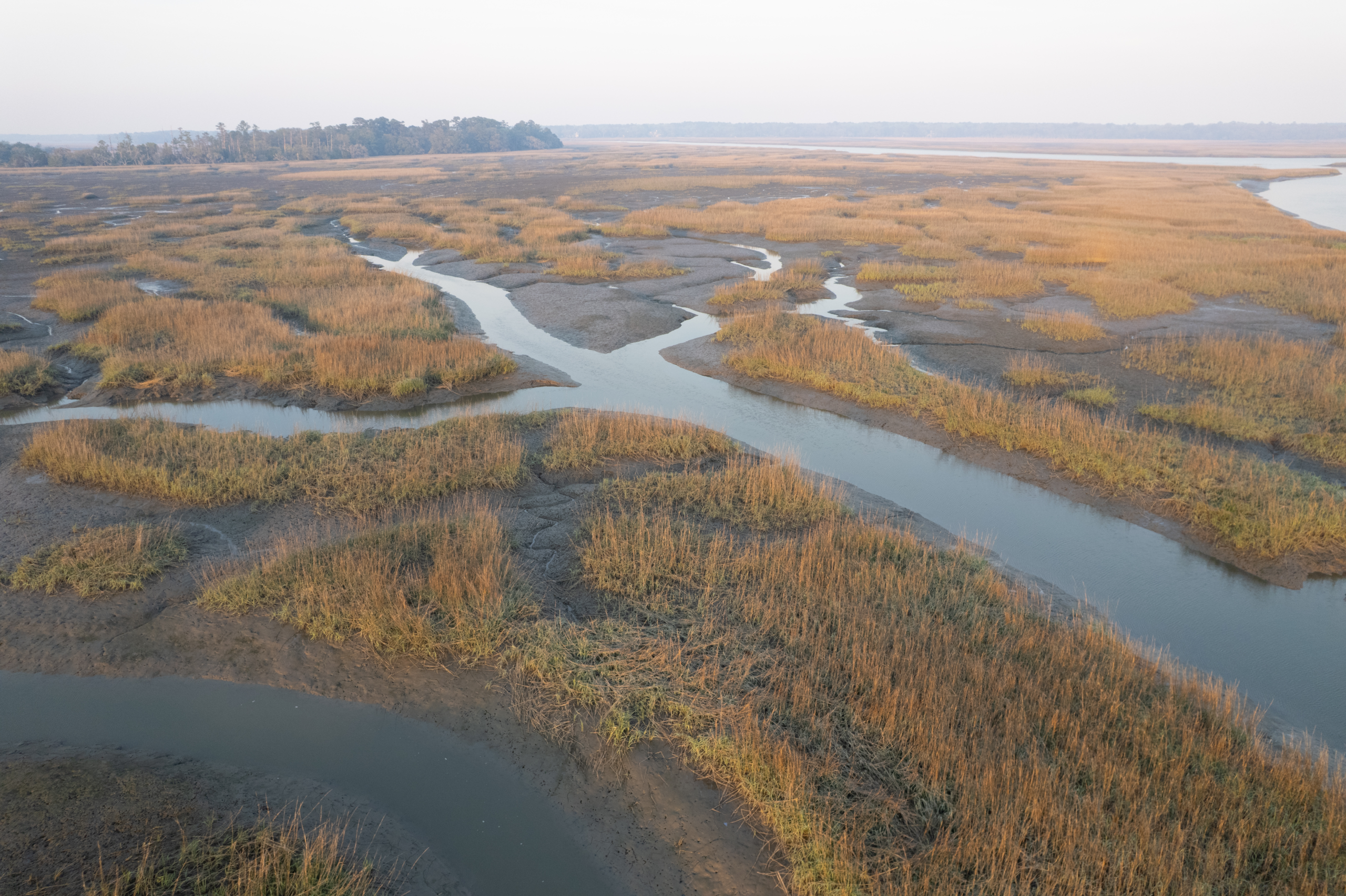
We left Isle of Hope Marina, just south of Savannah, by 0700 the morning of March 19th, headed to our next stop at Beaufort, South Carolina, 55 miles away. Beaufort, SC is pronounced ‘Byoo-fert,’ not to be confused with Beaufort, NC, which is pronounced ‘Bow-fert.’ We were warned that locals in both places take great offense when the pronunciations are mixed up. It was a beautiful ride to Byoo-fert surrounded by low country marsh.


By late afternoon we dropped anchor just off downtown Beaufort, SC and settled in for dinner onboard. The next morning, we were off early in the dinghy to explore historic Beaufort. After locking the dinghy to the free town dock, we wandered along Bay Street, then made our way to the Visitors Center to get oriented. We decided to book a golf cart tour with Beaufort Tours to better understand the town’s history, and to learn something about the huge number of beautifully preserved historic homes that packed block after block of the town’s oak tree lined streets.
Our golf cart tour guide was fantastic. She combined the rich history of Beaufort during the Civil War (it was where the confederate rebellion was initially fomented), with interesting stories of the town’s notable residents (Harriet Tubman and Clara Barton both spent extended time in Beaufort) and gorgeous antebellum homes (they were everywhere – the entire town is a beautifully preserved historic district), and then touched on the town’s current claim to fame as the location of the filming of several well-known movies (The Big Chill, and Prince of Tides, to name a few).


Our guide ended the two-hour tour with a story that brought me to tears. During the war, Robert Smalls, an enslaved man from Beaufort, had been pressed into service piloting a Confederate ship, and when he learned that his wife and child were about to be sold, in an act of desperation one night, he snuck them onboard while the white officers were away, and then fled in the boat towards the Union blockade. When the Union saw that the Confederate boat steaming towards the blockage was being piloted by an African American crew and was being pursued by other Confederate ships, they opened the blockade to allow the boat to take cover behind the blockade lines. Not only did Robert Smalls deliver a Confederate ship into the hands of the Union, the ship included valuable cargo – Confederate codebooks, maps, ammunition, cannons, and information about local mines. Mr. Smalls went on to become a Union naval hero (the first black US Navy captain), commanding during the remainder of the war the ship on which he had absconded. After the war, Mr. Smalls returned to Beaufort and was elected to Congress. He purchased the Beaufort home of his former enslaver (the McKee family) which was being sold for back taxes. Many years later, his former mistress, the now elderly Mrs. McKee, was suffering from dementia and one day she wandered into the kitchen of her former home, sat down, looked at Smalls, and commanded, “Bobby, get me something to drink.” So far as she knew, it was still her home, and Smalls was still hers to command. After considering the situation, Robert Smalls and his wife decided that the Christian thing to do would be to move out of the master suite, and they allowed Mrs. McKee to live there the remainder of her life, being tended to by them.

After the wonderful tour, we decompressed over pizza at Panini’s, overlooking the water. After lunch, Chris went to get a pedicure, while George continued sightseeing. He toured the Reconstruction Era National Historic Park, the Pat Conroy Literary Center, and the Beaufort National Cemetery. We met back up late afternoon on the patio of a bar reportedly frequented by Ernest Hemingway, then headed over for an early dinner at the famous Old Bull Tavern. We were back on the boat by sunset, and an early evening to bed.

Frequent shifts in the dramatic South Carolina tide (a 8’ to 9’ tidal swing), combined with shallow water at low tide, resulted in incessant chain scraping noise throughout the night, so we hauled anchor the next morning, March 21st, and headed to another anchorage closer to Charleston. After forty-nine miles, we anchored in Church Creek, along with a motor catamaran that we had followed most of the day. Kirk and Lisa from Catalyst II motored over in their dinghy to introduce themselves, and we enjoyed visiting for about an hour. The no-see-ums were ferocious, so we hunkered down inside. The next morning, Catalyst II departed, but we elected to stay put for another day to start catching up on updates to our website. We had a relaxing slow day secluded in the middle of the picturesque marsh.


The next morning, we had considerable difficulty pulling up the anchor chain; the chain links kept slipping out of the windlass gypsy, which is essentially the rotating “teeth” inside the windlass that engages the chain links as they are pulled up. George overcame the problem by using his foot to keep pressure on the chain, then made a note to order a replacement gypsy and add that to our ongoing boat project list. It is always something. We left Church Creek with the flood tide running in our direction picking up a few additional knots of speed from the current. We rode that all the way past Rantowles Creek where we lost the tide push and our speed slowed considerably.
We arrived at Safe Harbor Charleston City Marina near slack tide, so we easily pulled into our assigned spot along their outer mega dock. After checking in and getting our gate codes, we cleaned Assisted Living both inside and out in anticipation of the arrival of our Panama City friends, Norbert and Connie Gittard. The Gittards have a condominium in Charleston and scheduled their spring visit to coincide with our time there. They arrived late that afternoon and we hung out on Assisted Living getting caught up on all the news from home, then went for the first of many memorable meals. Charleston is a foodie paradise – the number and variety of top-notch restaurants can be overwhelming. Fortunately, the food scene is Connie’s forte, and she meticulously researched, planned and secured reservations for a gastronomic tour of some of the city’s finest restaurants. We were determined to eat our way through Charleston. First up was a charming French restaurant, Brasserie Le Banque, where George enjoyed a seafood medley with lobster, and Chris had a perfect filet. We paired it with an elegant red wine blend that required the sommelier to scale a twelve-foot ladder to retrieve the bottle from the restaurant’s upper most wine cabinet.


The next morning, Chris biked through historic Charleston to pick up prescriptions that she had transferred to the local CVS. Managing the refill of medications is a logistical challenge while doing the loop, but we have thus far managed by anticipating our likely stops when the meds will be due for a refill and then calling ahead to transfer to that location. For this segment, George was able to manage his meds by refilling in Panama City to be delivered to our home, where the Gittards retrieved them and in turn delivered them to him in Charleston. We are a little nervous about how we will manage the issue when we are in Canada for several months this summer but hope to be able to stockpile enough just before we leave the US to get us through.
While Chris went on her prescription run, George stayed on the boat to meet a Volvo mechanic who he had scheduled to address a leaking water pump in our starboard engine. Fortunately, we are still covered by an extended warranty, and that has two distinct advantages: one, obviously, is that the expense is covered by warranty; but as valuable is that hard to schedule certified Volvo techs are held accountable by Volvo to promptly address warranty issues and while it is near impossible to get on a good Volvo tech’s schedule, being under warranty likely tipped the balance (Lord help us in a few months when we are no longer under warranty). George had also arranged that morning to meet up with Todd Gallati, a former hospital CEO with whom George had worked closely during Todd’s time with HCA in Panama City. Todd has retired from hospital administration and now runs charters in Charleston on his catamaran sailboat (Everything Zen Charters). Shortly after Todd arrived at Assisted Living, Chris returned with goodies from La Patisserie, one of many excellent French patisseries in Charleston which we enjoyed while visiting with Todd. Before we knew it, the Gittards arrived to pick us up for our next culinary adventure, lunch at Magnolias, where the fried green tomatoes, atop gouda grits, drizzled with tomato beurre blanc is to die for.

After lunch, we dropped the guys off at Patriots Point Naval & Maritime Museum for an extensive four-part tour of the USS Yorktown. George and Norbert were thrilled to go through the nitty gritty of all the aircraft carrier’s systems, and Chris and Connie were equally thrilled to not be dragged along. The girls went shopping instead. After the tour of the Yorktown, the guys also went through the Vietnam Experience Exhibit, which they reported was very interesting, but possibly too intense for any Vietnam veterans.


After the ladies retrieved the gentlemen from Patriots Point, we headed over to James Island where the Gittards condo is located. Along the way, we did a quick run into Publix for food supplies for the boat, and to pick up another prescription for Chris (taking advantage of access to a car). We relaxed for a bit at the Gittard’s condo and then had another delicious meal, dinner at Le Farfalle (it seems we will be rolling out of Charleston, but darn it, it is worth it).

The next morning, Chris and George waited on the boat for the arrival of the mechanic, and were soon joined by Norbert, who is always game for helping with a project (his Panama City friends have affectionately nicknamed him “Project Man”). While we waited on the mechanic, George and Norbert dug into the issues with George’s electric bike and ultimately found that the problem was likely self-inflicted (as Scooby Doo would say, “rut roh”). Our unscientific troubleshooting tests (swapping the batteries between the two bikes) seemed to indicate that the problem was not with the wiring or any defective parts in George’s bike but instead was related to a drop in the connection with its battery. When using George’s bike battery in Chris’ bike, Chris had noticed that when she slammed on the brakes when George stopped in front of her without warning to take a photo (a frequent occurrence) that the bike lost power, but after a bit, it would come back online. Considering this, George and Norbert decided to attach some spacers to the bike battery to more firmly hold it in place. As they were cutting to fit a few 3M stickers we had scrounged up, George recalled that early on he “might have possibly… okay, probably had” removed some existing foam stickers from his battery because they made it difficult to get the battery in and out of its compartment. A quick view of Chris’ battery confirmed that her trouble-free battery indeed had some original spacers/stickers in place. Once we attached the 3M foam stickers to George’s battery, it worked like charm and has been working well ever since.
After several hours of waiting on the boat, we called the mechanic and learned that he had been delayed on another job. He promised to get to us by Friday, two days away. We had no choice but to extend our stay at the marina in Charleston. With our afternoon suddenly free, we decided that if we hurried, we would just make the last tour boat to Fort Sumpter. By this time Connie had joined us, so the four of us had a quick sandwich on the boat and raced over and took the ferry to the place where the first shots of the Civil War were fired. In addition to the remnants of the old fortification, there was an excellent museum.


After the trip to Fort Sumpter, Connie and Norbert took us to Folly Beach, where we made a stop at one of their favorite places, Taco Boy. After some excellent guacamole (because every stop involves food), we drove over to The James American Grill, for one last excellent meal with the Gittards, who were departing Charleston the following morning.
We spent the next morning route planning, then took off on our bikes to explore the beautiful neighborhoods of historic Charleston. We rode for miles along the Battery, admiring the exquisite homes and gardens, then toured the South Carolina Historical Society Museum. The historical society volunteer who welcomed us to the museum had such a thick South Carolina accent that we could only understand about every fifth word he said. We eventually made our way over to the Charleston City Market, but after a quick peek at the trinkets and treats for sale, we biked over to the waterfront, then back through the Battery and on to the marina. Since we had basically eaten for three days straight, neither of us felt up for dinner that night, so we stretched out on the converted lounge space in the salon and watched the movie The Big Chill on our big screen TV. It was fun recognizing the spots in Beaufort where the movie had been filmed.


The next morning, March 27th, the mechanic showed up at 0900 to do the warranty work on the engine water pump. While George hung out with the Volvo mechanic, Chris took the marina courtesy shuttle to West Marine (every day at 1100) to pick up a replacement raw water pump (another pump that needed to be replaced; it is indeed always something). When she returned and we unboxed what was supposed to be a brand-new pump, it had water inside – a sign that the pump might have been used. George called West Marine and spoke to the manager, who couldn’t explain or excuse what happened, but who did offer to deliver a new replacement to us that evening on his way home from work. Despite the error, we were duly impressed with the exceptional customer service.

Later that afternoon, dockhands from the marina came pounding on our windows, warning us that a boat anchored just across from us was dragging its anchor and looked likely to drag into us. Apparently, the same boat had broken free the month before and damaged a few boats docked on the outside of the marina mega dock, which is where we were located. We pulled out every spare bumper we had and braced Assisted Living for impact. As the derelict boat moved closer to us, the US Coast Guard swooped in, boarded the boat, pulled it across the anchorage and re-anchored it. We were stunned. Go USCG!
That evening we indulged in one last excellent Charleston restaurant, 39 Rue de Jean. Connie and Norbert had taken us there on a previous trip to Charleston. It was as good the second time around. The difference was that this time we rode our bikes there and back.

The next morning, the forecast was for a building north wind so we wanted to get off the dock early to get across Cooper River before it got rough. Before leaving, we warm up the Gyro (our stabilizer), and it worked well to smooth out our ride as we headed past the Battery and across Charleston Harbor between Fort Sumpter and Shutes Folly Island (Fort Ripley). Unfortunately, the Gyro’s internal inverter got hot and the stabilizer shut down (apparently a known issue with the Quick Gyro MC2). As soon as one item is checked off the boat projects list, it seems another is added. At the west end of Sullivan Island, we re-entered the ICW, and we were back in the salt marshes of the low country. We were approaching dead low tide in a rather shallow stretch of water, but following the Holy Grail, Bob’s Tracks, kept us out of trouble. We arrived at South Santee River hoping to anchor but realized that it offered little protection from the northeast wind (20 knots and gusting to 30), so we pressed on and explored two more possible anchorage before finally settling in further up the North Santee River at Minim Creek. The wind and the current were in opposing directions, so anchoring was an exercise, but we managed to get a good bite. George took on the job of replacing our raw water pump for the head (the one the West Marine store manager had personally hand delivered), then we switched on the diesel heat for a cozy night at anchor.


The next morning, March 29th, the wind was still blowing 15 – 20 knots. Assisted Living’s engines had to work hard against the wind and current to pull up the anchor. We made the relatively short hop (15 miles) to Georgetown, South Carolina, a charming small town full of historic homes from the 1700s and 1800s. We had planned to stay at the free town dock, but on closer inspection it looked a little sketchy, so we hastily arranged a slip at Harborwalk Marina. There is an anchoring basin near town, but it had mixed reviews, and with the stout wind blowing, we decided we’d rather be secured to a dock. We’d been warned prior to starting the Loop that most boats end up spending more nights at a dock than originally planned, and that has certainly been true in our case.
We used our bikes to ride all over town. George was so thrilled to finally have a functioning electric bike that he led us far and wide on what seemed like a tour of every street in town (and, I noticed, a few streets more than once). We biked to the farthest point on the peninsula to the ruins of a revolutionary fort and park overlooking the Great Pee Dee River (the name alone tells you we are in the deep South), then wandered aimlessly through residential streets admiring the historic homes. Eventually we worked our way to the main commercial drag, but were disappointed that nearly all the businesses, restaurants and museums were closed (but it was, after all, a Sunday afternoon). The official website of Kaminski House said that the antebellum home/museum was open, but when we biked over the doors were locked, so after strolling through its waterfront gardens, we headed back into the interior of town to explore a historic church and graveyard. The weather had finally warmed up, and the sun was shining (Hallelujah!), so we finished off the afternoon hanging out in the sun on top of Assisted Living’s flybridge. Later, we strolled along the town’s waterfront boardwalk to have a burger at the Buzz Roost.


The next day, the marina allowed us a late checkout so we could visit a few of the sites in town that had been closed the day before. On our way out of the marina, we saw Kirk from Catalyst II, and he chased us down to let us know that he had a rental car for the rest of the afternoon and to offer to drive us if we needed to pick up any supplies or run any errands. The cruising community is so awesome. We were well stocked from our time with the Gittards (and their car) in Charleston, so didn’t need to take him up on his very kind offer.
The Rice Museum was still closed, but we were able to do a private tour of the Kaminski House. The house was originally built in the 1700s, but the tour focused on the last permanent residents, who were socialites and philanthropists who lived in the house from the 1930s to the 1970’s. The home and its contents had been bequeathed to the City, with the stipulation that nothing could be removed from the home. Consequently, it was like a time capsule from that era.

On the way home from the Kaminski House, we did a quick tour of the South Carolina Maritime Museum. At the sidewalk tables at a restaurant near our marina, we ran into Ed and Allison from Love Me Fender. It would have been fun to join them, but we did not want to abuse the marina’s hospitality by overstaying our welcome, so we headed back to the boat and were off the dock before noon.

We were on a beeline to Wacca Wachee Marina fuel dock at Murells Inlet, SC. According to Looper lore, they consistently have the cheapest diesel we will find on our trip. With the ongoing disruption in the Middle East, diesel prices had soared, so we were highly motivated to get there before they closed, so we could fuel up with “cheap fuel” before heading to our anchorage for the night. We pulled up to the Wacca Wachee fuel dock (don’t you love that name) with plenty of time to spare (aided by a 15-minute speed run at over 20mpg since the Volvo techs had told us that we occasionally need to go fast to blow out any carbon that we have been accumulating). We were grateful for diesel priced at $4.99/gallon, which is a price we would have never dreamed of being grateful for when we started this trip with diesel at $3.61/gallon.
We continued to an oxbow of the Waccamaw River by Socastee Creek, west of Myrtle Beach, to a quiet anchorage. Already anchored there was a Monk 36 trawler, Antonia, that we had seen anchored in the basin at Georgetown. Once we got the anchor settled, Neill from Antonia, with his enormous (but sweet) dog, dinghied over to introduce themselves and visit for a bit. Neill and his wife Joannie are Canadians who have already completed the Loop once and are now spending the winter on their boat in the south. Chris had dinner in the oven before the anchor was down, so shortly after Neill and puppy departed, we had dinner, then converted the salon settee into a large lounge area and stretched out to watch the movie, The Prince of Tides. We are finding it a special treat to watch old movies filmed or set in the areas we have recently visited.


The next morning, March 31st, George was up at 0630 to drone, and try out a nifty little drone landing pad that he had constructed on the flybridge using the blowup paddle board, the removable top of our flybridge table and cushioning from the engine room floor. It worked beautifully, solving one of his biggest problems (the drone does NOT like all the metal on the flybridge and therefore sometimes hesitates to follow his landing commands). After sharing with Neill and Joannie some of the drone photos that included shots of Antonia, we pulled anchor and headed north on the Waccamaw River.


The river edge was covered by gorgeous cypress trees, until we reached Myrtle Beach, where the houses were cookie-cutter and the land was clear cut – not a good look. Just for navigation fun, there were rock ledges on the edges of the ICW. It seems likely that a canal was cut for the ICW out of solid rock. We passed several golf courses, but otherwise Myrtle Beach looked a lot like the strip on Panama City Beach. We passed through 14 bridges, two which had to open for us, but the others were either already open or were high enough that we could pass under. Along the way, George spoke with Robert Creech, Looper legend, and Harbor Host extraordinaire from Southport, NC, who helped us plan our upcoming route segments, and suggested a better spot for anchoring that evening.
Following Robert’s advice, we left the ICW and headed to Little River inlet, where we ducked just inside a strip of sand to a perfectly protected anchorage with a long beach attached to the mainland. It reminded us of Shell Island, but with a direct opening to the Atlantic Ocean. We launched the dinghy before killing the engines and ran over to the pristine beach. As we walked along the beach, we passed a sign that told us were now in North Carolina. The beach was brown, course and devoid of any shells. There were half a dozen people riding a bike along the packed, hard sand. George took a short dip in the Atlantic, while Chris waited for him onshore bundled up in her offshore jacket over a sweater.


We returned to the boat where George tackled a newly discovered problem – the depth finder on the dinghy was kaput. He treated the dinghy’s MFD connectors with Corrosion X, and like magic, the depth gauge worked perfectly. Flush with victory, he undertook the regular maintenance tasks on our heads (the toilets) – ahh, the glamor of living on a “yacht.”
George has put together a video with some beautiful drone videos and photos of our time in South Carolina. The “glamor” of this adventure may be tongue in cheek, but the beauty of the low country is quite real – indeed, it is spectacular.