
The next morning, February 23rd, we were up at 0630 to fill the water tanks and get underway to St. Augustine. It was downright cold in the strong north wind, so after a brief stint driving from the flybridge, we decided that it was a day for the inside helm (such a luxury to have both). Having learned our lesson about current in New Smyrna, we called ahead to the St. Augustine Municipal Marina and learned that slack tide would be at 1330. That was earlier than we had thought, so we decided to burn a little (a lot) more diesel to make sure we arrived at slack tide. In the meantime, the apparent wind increased to 30 – 35 mph. Docking with strong current was no fun, and docking with strong current plus severe winds would have been even worse. We put the pedal down to make slack tide, and it was worth every penny (actually, every dollar).
As we moved past Daytona, the landscape changed from majestic oaks to live oaks interspersed with palm trees. The Halifax River became the Matanzas River at Flagler Beach. We passed Palm Coast. As we approached St. Augustine, we passed Fort Matanzas National Monument, and saw the St. Augustine Lighthouse in the distance as we approached the huge city mooring field at St. Augustine. Just before the famous Bridge of Lions, we entered the St. Augustine Municipal Marina and docked in a huge slip in the heart of historic St. Augustine.


The marina was perfectly positioned to explore the old city by foot. That first afternoon, we walked a few blocks to the Lightner Museum, which is housed in a magnificent building, the former historic Alcazar Hotel developed by railroad tycoon Henry Flagler. The museum’s collections and exhibits were excellent, featuring Victorian era artifacts, excesses from the Gilded Age, a diverse art collection, and a special exhibit of antique bicycles. As good as the museum exhibits were, we were equally impressed with the architectural features of the building itself. After a few hours at the museum, we only had to cross the street to explore another exceptional Flagler Building, the historic Ponce de Leon Hotel, now the centerpiece of Flagler College.


We topped off the afternoon with a visit to the St. Augustine Distillery. Our son-in-law, Ryan, is a bourbon aficionado and had been researching distilleries along our route that he thought we should visit. While George tasted a flight of bourbons, I wandered around checking out all the bourbon related gift items. I came close to purchasing a t-shirt for our son-in-law with the saying, “I wonder if there is a bourbon out there thinking about me, too.” Upon further reflection we decided that it might not be appropriate for the 5-year old T-ball game circuit where Ryan currently spends most of his off-working hours, but it sure was cute.


As we walked back towards the marina, we found a relatively new restaurant specializing in farm to table fare and enjoyed a healthy dinner. We were back on the boat by sunset and golden hour, and George enjoyed droning, taking care to avoid flying over Castillo de San Marcos, the historic 16 century Spanish fortification which was located just beyond the marina.

The next morning, we tracked down a notary public and Fed Ex office because we needed to sign some documents for an upcoming real estate closing. We found a service about a mile away and it was on the way to the St. Augustine Lighthouse, so we biked over the Bridge of Lions, took care of the paperwork, then biked on to visit the St. Augustine Lighthouse & Maritime Museum. From there, George wanted to visit the Alligator Farm, so we parted ways for the afternoon, then met back up in historic old town after he’d had his fill of reptiles. The Spanish Military Hospital Museum was full of grade school children on a field trip, so we skipped that and instead toured the Ximenez-Fatio House Museum. The house was originally built in 1798 by a Spanish merchant, then later converted to an upscale boarding house owned by a series of single women over the centuries. Each room was furnished with items that would have been in use over various periods in the home’s history, and the in-depth audio-tour explained how each room functioned and what life was like for the long-term boarders who visited the home for months at a time. Before returning to the boat, we toured the heart of old town along St. George Street, which today includes many preserved buildings now selling t-shirts, trinkets and state fair like food for tourists. When we reached the historic City Gate, we ambled over to the waterfront with a view of Castillo de San Marcos, then found a rooftop bar where we enjoyed refreshments while overlooking the fortification.

When we returned to the marina, the empty spots along our dock were soon filled with heavily armed FWC boats. George had just about been ready to launch his drone, but decided to hold off, but the FWC officers just stayed and stayed, cleaning off their boats and unloading gear. The next thing I know, I see George down the dock in the middle of the FWC officers, yuckin’ it up and asking questions. Turns out FWC boats were gathering in St. Augustine for some training exercises. The other law enforcement boats we saw milling about were there because the Florida Governor was in town to make an announcement. Confident that he was now friends with the officers, he returned to the boat and launched his drone from the dock, then grilled chicken for dinner while smoking a cigar (the man likes to multi-task).

George spent the next day touring the sights in historic St. Augustine. Chris decided to stay on the boat to work, mainly because she had visited all the major St. Augustine sights on three prior occasions on school field trips with each of our three children. After a park ranger tour of Castillo de San Marcos, George went to the St. Augustine’s Shipwreck Museum, which he reported was geared more to its target audience of antsy school children. He visited the beautiful Cathedral Basilica of St. Augustine and walked through several plazas and squares, full of statutes, memorials and plaques to the area’s rich history.

That evening we were joined on the boat by a Tulsa school friend of Chris’, Scott Felts and his wife, Nancy, who had driven over from Ponte Vedra. Scott and Chris went to school together from elementary through high school and we had a wonderful time catching up and getting to know Nancy better. Scott has lived in northeast Florida for many years and is also an experienced boater, so he shared lots of great information with us about the area, including some good tips for our planned side trip south along the St. Johns River. We made plans to meet again after our St. Johns River adventure, likely in Fernandina Beach.
The next morning, February 26th, after a quick stop at the fuel dock, we headed for Jacksonville, Florida. We traveled 58 miles and under eleven tall bridges. We passed mainly marshes, wilderness and several preserves, but once we arrived at St. Johns Inlet, we passed miliary installations and heavy industrial areas (Mayport Naval Air Station; Port of Jacksonville). As we neared Jacksonville proper, we started seeing stately waterfront homes surrounded by oak trees draped in Spanish moss. There are several free municipal dock walls along the riverfront in downtown Jacksonville, but they are all first come first serve, and even if we were to find a spot available, we were unsure whether it would be a secure place to stay; so we opted instead to take a slip at Plaza Marina, a condominium complex dock along the north bank of the river, with easy access to Jacksonville’s miles of riverfront public walkways. It was late afternoon when we arrived, but after a full day of motoring in the boat, decided to go for a long walk to get a little exercise and explore our immediate neighborhood. We walked along the wide riverfront boardwalk as far as possible and were diverted off the path several times by ongoing construction or repair projects. We ducked a few blocks to landward and worked our way back to the boat, stopping for a quick dinner at Cinco de Mayo, a Mexican restaurant that had been recommended by the dockmaster.


The next day the forecast was for late afternoon rain, so we decided not to use our electric bikes, and instead hiked over to the Jacksonville Visitors Center to work out our itinerary for the day. Years ago, Jacksonville received a massive federal grant to build an elevated tram called the Jacksonville Skyway, and although its ridership has come nowhere near to predictions and far from economic sustainability, apparently the city would have to return to the feds approximately $100 million if it ceased its operations. At present, the available stops are not very useful for exploring the city, but the tram does connect the north and south banks of the St. Johns River, so it was a convenient way for us to get over to the south bank of the river to explore the boardwalks, parks and memorials that were on the opposite side. We admired the Lone Sailor statute, and a stunning mosaic along a pedestrian tunnel, and checked out Friendship Fountain and playground. We ran out of riverwalk but continued nearly two miles past massive hospital compounds to reach the Fuller-Warren Pedestrian Bridge which runs adjacent to I-95 and was our only way on foot to cross back over to the north bank.


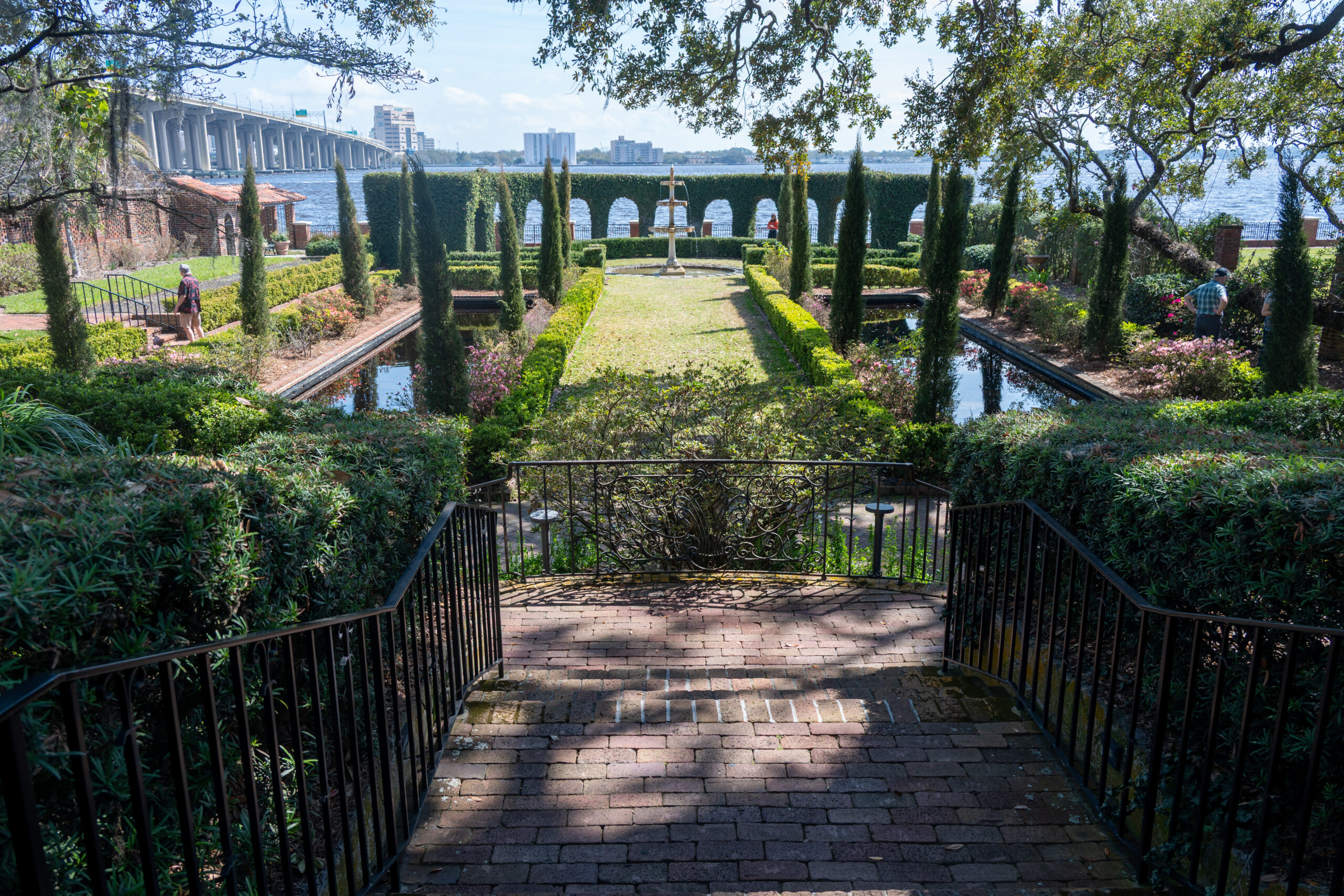
The pedestrian bridge deposited us on the north shore near our next destination, the Cummer Museum of Art and Gardens. The museum’s founder and primary benefactor had donated her large riverfront estate and an impressive art collection. Over the years, the collection grew and it is now housed in a new modern building on the site, surrounded by a collection of gardens overlooking the river. Although the museum was compact, it’s permanent collection of art was superb, with many impressionist paintings which we particularly enjoyed. There was also an interesting temporary exhibit of German porcelain (Messin). We also enjoyed the outdoor collection of gardens in various styles – Italian, English and Sculpture. In the center of the gardens was likely the most massive live oak tree either of us had ever seen. The tree’s branches spread in all directions across the entire back lawn, twisting and dipping from their weight all the way to the ground, where the branches would take root again in the ground, then rise and continue. The photos we took hardly do it justice.


The museum was only a few blocks over from a German restaurant we had read about, so after our visit to the Cummer, we walked over for lunch at Hoptinger. We had initially planned to enjoy their rooftop seating, but it looked like rain was threatening to come in earlier than forecast, so we enjoyed our brats inside.
As we departed Hoptinger’s the sky looked even worse, but as we started the 2.5 mile walk back to the boat, we hoped that the really bad stuff would stay to the north of us – and we almost made it — but not quite. The darker the sky, the faster we went; from fast walking, to trotting, to outright running. Just as we passed the Jacksonville Symphony Hall, the beer that George drank with his brats demanded to be recycled, and as the first raindrops fell, he rushed into their building to find a men’s room. Chris was tucked under the eaves of the building when the sky broke loose and started dumping buckets of water. We huddled there together for a good ten minutes. Radar indicated that the rain was not going to stop anytime soon, and the forecast was for steady rain all night long. We considered calling for an Uber ride, but when we checked found that it’s infamous “surge pricing” was in effect. Forty-five bucks to go less than a mile? No thanks. When the rain went from buckets to pitchers, we pulled up the hoods of our rain jackets and splashed through the flooded streets back to Assisted Living. With what was left of the day, George took a Lyft (no more Uber for us) to Batteries Plus and bought a replacement starter battery for our starboard engine. We had noticed an increasing hesitation between the start button and that engine turning over, so thought it best to be proactive.

The next morning was dark and dreary. Chris stayed on the boat to work, but George went one dock over to tour the floating USS Orleck Museum Ship. The USS Orleck was a World War II era destroyer that served in Vietnam and North Korea and then was sold to Turkey. She came back stateside to Los Angeles, but broke free of her mooring and found a home in Jacksonville (likely a bit more to that story, but that’s all he got). The tour was incredibly well done, with videos, motion sensor audio, and even holograms at important sites. When he returned to the boat, he installed the new starter battery, then fired her up and we took off headed for the FCYC club in Jacksonville, Florida Yacht Club.


Florida Yacht Club has a gorgeous new clubhouse, a resort type pool and spa, and brand-new docks with a substantial rock breakwater that made docking in their protected marina off the St. Johns River a breeze. They also had some of the friendliest staff and members that we have encountered so far; and that is a high bar, because every one of the FCYC clubs we have visited has been gracious and welcoming. We had a delicious dinner at the club that evening, surrounded by families with young children and even one table of eight 14-year-old girls celebrating a birthday. We could not have been more impressed with how well-behaved and lovely they all were – from toddlers to teens. It was so refreshing to see. We made a point of complimenting their parents and the club staff. Impressive, indeed.
We returned to Assisted Living and were off to bed early in anticipation of an early start the next morning. We would be heading south inland down the St. Johns River for a 300-mile round trip to explore central Florida.
Check out the video George put together of our visit to Florida’s First Coast.